

The climate crisis is no longer a future scenario, it is the direct result of decisions companies make today. Making its impact felt across energy costs, supply chains, regulations, and investor expectations, this crisis has inevitably placed organizations at the center of the carbon footprint calculation process.
The real question for companies today is no longer whether to calculate their carbon footprint, but how comprehensively, how accurately, and how actionably they do so.
In this guide, for organizations just beginning carbon footprint measurement or those already running the process — we cover: GHG Protocol-compliant calculation methodology, the corporate carbon footprint approach, the carbon footprint report creation process, the Scope 1-2-3 distinction, and carbon footprint reduction strategies.
What is a Carbon Footprint?
A carbon footprint is the total greenhouse gases released into the atmosphere, directly and indirectly, by a person, organization, or product. These emissions are measured in carbon dioxide equivalent (CO₂e) and quantify the contribution to climate change.
A corporate carbon footprint covers the greenhouse gas emissions generated across all of a company’s activities. It’s not just the smoke from a factory chimney, it spans a wide impact area, from the raw materials you purchase to how your employees commute, to how your products are used by customers.
Why Should a Carbon Footprint Be Calculated?
Regulatory Pressure is Increasing
The European Union’s Corporate Sustainability Reporting Directive (CSRD) has been gradually coming into force since 2024. For companies operating in Turkey and trading with the EU, this directive is becoming directly binding. Turkey’s own climate legislation is also taking shape rapidly: greenhouse gas monitoring and reporting obligations under the Ministry of Environment, Urbanization and Climate Change are expanding.
Particularly for heavy industry sectors exporting to the EU, CBAM (Carbon Border Adjustment Mechanism) transforms emissions reporting from a mere obligation into a direct cost and tax item.
Investor Expectations are Changing
ESG (Environmental, Social, Governance) criteria are now an inseparable part of investment decisions. Companies that fail to measure their carbon footprint and present a reduction plan find themselves at a disadvantage in terms of both financing costs and reputation.
Supply Chain Requirements
Global brands are demanding carbon data from their suppliers. Companies that cannot report Scope 3 emissions face the risk of being excluded from value chains.
How is a Carbon Footprint Calculated?
At the corporate scale, carbon footprint calculation is not merely assembling emission factors, it is a technical process requiring consistency in scope, data quality, and methodology. For ESG and sustainability teams, the core goal of this process is to create a comparable, auditable, and actionable emissions inventory.
The internationally recognized GHG Protocol Corporate Standard addresses carbon footprints under three main scopes, and the calculation process is structured accordingly.
Defining Scopes (Scope 1, 2, and 3)
Scope 1 (Direct Emissions)
Emissions directly released from sources owned or controlled by the company.
Examples:
- Natural gas, fuel oil, coal combustion at facilities and factories
- Fuel consumption of the company’s vehicle fleet
- Chemical reactions in production processes
- Refrigerant gas (HFC, PFC) leaks
Data Sources: Invoice data, fuel purchase records, process measurements
Scope 2 (Indirect Energy Emissions)
Emissions arising from purchased electricity, heat, steam, or cooling. Although energy production occurs outside the company, consumption is within the company’s control.
| Method | Description | When to Use |
|---|---|---|
| Location-Based | Grid average emission factor | Default calculation |
| Market-Based | Supplier-specific emission factor | When green energy certificates, I-RECs, or PPA agreements are in place |
Example: Turkey’s grid emission factor is approximately 0.45–0.50 kg CO₂e/kWh. A company purchasing renewable energy certificates can reduce this figure in a market-based calculation.
Scope 3 (Other Indirect Emissions)
All emissions generated along the company’s value chain, outside its direct control. The GHG Protocol divides Scope 3 into 15 categories:
Upstream Categories:
- Purchased goods and services
- Capital goods
- Fuel and energy-related activities (outside Scope 1–2)
- Upstream transportation and distribution
- Waste generated in operations
- Business travel
- Employee commuting
- Upstream leased assets
Downstream Categories:
- Downstream transportation and distribution
- Processing of sold products
- Use of sold products
- End-of-life treatment of sold products
- Downstream leased assets 14. Franchises 15. Investments
Why is Scope 3 So Critical?
In most sectors, Scope 3 emissions account for 70–90% of total carbon footprint.
Consider an automotive manufacturer: while energy consumption at the factory (Scope 1–2) represents a small fraction of the total impact, the steel, plastics, and electronic components sourced from suppliers and the fuel burned over the vehicle’s lifetime (Scope 3) create the real impact.
Consequences of excluding Scope 3:
- The company’s true carbon profile is not reflected
- The majority of reduction potential remains invisible
- SBTi (Science Based Targets initiative) targets cannot be set
- CSRD compliance cannot be achieved
Most Common Mistakes in Carbon Footprint Calculation
Although a large proportion of corporate companies have started carbon footprint calculation, the same mistakes keep recurring:
1. Ignoring Scope 3 The most common mistake is limiting calculation to Scope 1 and 2. This approach is like measuring only the visible tip of the iceberg.
2. Getting By with Estimates Accessing data on supply chains, logistics, and procurement can be difficult. However, relying on “estimates” reduces the report’s credibility. Prioritizing through a materiality analysis is better than estimating everything.
3. Manual Excel Spreadsheets For a company with hundreds of suppliers, dozens of facilities, and thousands of SKUs, calculating via Excel both increases the risk of error and is unsustainable. It requires starting from scratch every reporting period.
4. Confusing Calculation with Reporting A carbon footprint report is not an endpoint, it’s a starting point. If there is a report but no roadmap, the calculation has not achieved its purpose.
5. Failing to Update Emission Factors Emission factors from sources such as IPCC, IEA, and DEFRA are updated annually. Calculating with outdated factors makes year-on-year comparisons meaningless.
👉 Check out IEA 2025 Emission Factors.
Carbon Footprint Calculation: Step-by-Step Process
Step 1: Define Organizational Boundaries
The first decision is which entities to include in the calculation. There are two approaches:
- Financial Control: All operations included in the company’s financial statements
- Operational Control: All facilities where the company makes operational decisions
Most companies prefer the operational control approach, as it covers the areas where they have direct influence over emissions reductions.
Step 2: Conduct a Materiality Analysis (for Scope 3)
It is not practical to calculate all 15 Scope 3 categories in equal detail. Use materiality analysis to answer:
- Which categories account for the majority of total emissions?
- Which categories have high reduction potential?
- Which categories are strategically critical?
Step 3: Collect Data
Primary Data: Direct measurements and records (preferred)
- Energy invoices
- Fuel purchase records
- Supplier declarations
Secondary Data: Industry averages and estimates
- Spend-based calculations
- Sector emission factors
Data quality pyramid: Supplier-level primary data > Activity data > Spend-based estimate
The New-Generation Standard: Double Materiality As of 2025, with the EU’s CSRD, the concept of “materiality” has gained a new dimension. You are now expected to measure not only your company’s impact on the environment, but also the impact of climate change on your company:
- Environmental Impact (Impact Materiality): The direct impact of your company’s activities on nature and society (e.g., your carbon emissions’ contribution to global warming).
- Financial Impact (Financial Materiality): The effect of the climate crisis and changing regulations on your company’s financial position (e.g., the risk of water scarcity halting your production line, or the impact of carbon taxes on profitability).
This two-directional perspective ensures your sustainability report is not merely a “goodwill certificate,” but also a strategic risk management tool.
Step 4: Select Emission Factors
Use up-to-date emission factors from reliable sources:
- GHG Protocol: Methodology and guidelines
- IPCC: Scientific emission factors
- IEA: Energy sector factors
- DEFRA: UK government factors (widely used)
- EPA: US factors
For Turkey, TÜİK and EPDK data can also be referenced.
Step 5: Calculate and Verify
Basic formula: Emission = Activity Data × Emission Factor
Example: 100,000 kWh electricity × 0.47 kg CO₂e/kWh = 47,000 kg CO₂e = 47 tonnes CO₂e
Post-calculation verification questions:
- Are the results consistent with sector averages?
- Can year-on-year changes be explained?
- Have data gaps been documented?
Carbon Footprint Report: What Should It Cover?
An effective carbon footprint report should include the following sections:
1. Executive Summary — Total emissions, scope breakdown, comparison with the previous year
2. Methodology — Standard used, boundaries, emission factors, data quality assessment
3. Emissions Inventory — Detailed breakdown of Scope 1, 2, 3, category-based analysis
4. Trend Analysis — Year-on-year comparison, intensity metrics (tonnes CO₂e/revenue, tonnes CO₂e/product)
5. Reduction Targets and Roadmap — Short, medium, and long-term targets, planned actions
6. Verification Statement (if applicable) — Third-party verification results
How to Reduce a Carbon Footprint? The Question That Follows Calculation
Calculation is the first step toward reduction. Real transformation comes through data-driven actions.
Reducing a carbon footprint is not possible through one-off projects or symbolic steps. Especially at the corporate scale, reduction can only be achieved with the right data and continuity.
Scope 1 Reduction Strategies
- Electrification of facilities and vehicle fleet
- Process optimization for fuel efficiency
- Detection and elimination of refrigerant gas leaks
- Transition to low-carbon fuels
Scope 2 Reduction Strategies
- Energy efficiency projects (lighting, HVAC, motors)
- Renewable energy supply agreements (PPAs)
- Rooftop solar energy investments
- Green energy certificates (I-RECs)
👉 Apply now to obtain your I-REC certificate with Apollo!
Scope 3 Reduction Strategies
Scope 3 reduction requires going beyond the company’s direct control:
- Supplier management: Selection of low-carbon suppliers, supplier engagement programs
- Product design: Low-impact product development through lifecycle analysis
- Logistics optimization: Route planning, modal shift (road to rail)
- Employee engagement: Remote work policies, sustainable commuting incentives
Carbon Offsetting
When reduction strategies alone are insufficient, carbon offsetting comes into play for unavoidable emissions. However, there are important points to consider:
- Reduce first, then offset: Offsetting should not replace reduction efforts. The priority should always be reducing emissions at the source.
- Choose quality projects: Projects with international standards such as Gold Standard and Verra (VCS) should be preferred.
- Additionality criterion: Would the project have occurred without carbon financing? This question is critical.
- Opportunities in Turkey: Forestry, renewable energy, and methane capture projects offer local offset options.
Carbon Footprint Calculation and Emissions Management with Apollo
Carbon footprint calculation, especially once Scope 3 emissions come into play, ceases to be sustainable through manual methods. Dealing with hundreds of data sources, thousands of SKUs, and constantly changing emission factors requires automation.
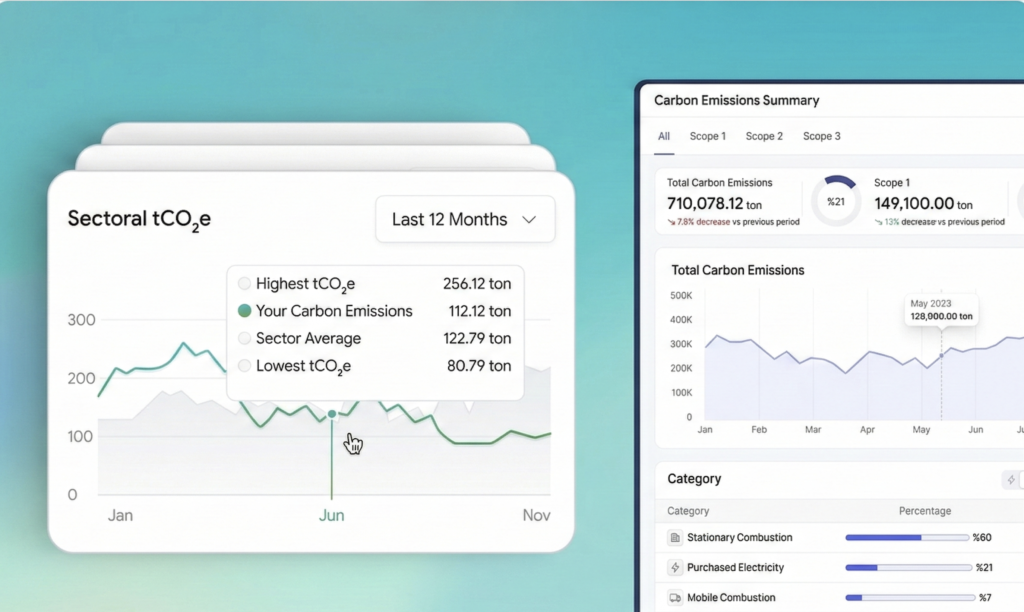
Apollo is a Sustainability Intelligence Platform (SIP) that addresses corporate carbon footprint management end-to-end.
Neden Apollo?
Automated Calculation: Automatically calculates Scope 1 and 2 emissions from your energy data in line with global standards.
Scope 3 Integration: Tracks, categorizes, and reports emissions generated across the supply chain.
Benchmarking: Enables you to compare against best practices in your sector to see your true potential.
How can you benchmark your carbon footprint against competitors? Read the details on the blog.
Data That Drives Action: Calculation is no longer data that sits in a report — it becomes a dynamic, continuously tracked process that highlights areas for improvement.
Apollo’s 3E approach (Energy–Economy–Ecology) also makes the financial return of carbon reduction visible. Because sustainability is only possible alongside economic sustainability.
Thanks to its user-friendly interface and rapid integration with existing infrastructure, teams can easily get involved in the process — and carbon footprint management transforms from report-bound data into a continuously tracked, living process.
For end-to-end carbon footprint management solutions, request a demo with Apollo today.