


For multi-location retailers, energy is not just a cost line. It is an operational variable that directly impacts profitability, sustainability targets, and long-term scalability.
At a high level, chain retailers are dealing with two fundamentally different problems:
1) Cost accuracy and optimization:
Are we paying the right amount for the energy we consume and where can we reduce costs?
2) Energy performance and efficiency:
Are our stores consuming the right amount of energy in the first place and where can we improve efficiency?
A Fragmented Reality Behind a “Centralized” Function
You’re managing hundreds of stores. Some sit inside shopping malls, others on high streets, some inside hotels or mixed-use developments spread across dozens of cities. On paper, energy management looks like a centralized function. In practice, it is one of the most fragmented, manually intensive, and underestimated challenges in the entire retail operation.
Each store is its own equation.
The climate conditions differ city by city; sometimes neighborhood by neighborhood. Architectural footprints vary. Customer profiles vary. Store concepts, segments, and themes vary. Square footage changes. Lease and energy contract terms differ. Utility suppliers change. And the equipment inside each store; the HVAC units, lighting systems, refrigeration, escalators; varies dramatically in age, model, and energy efficiency class.
When you put all of those variables together, what you have is not one energy management problem. You have hundreds of them, all running simultaneously, with very little shared infrastructure connecting them.
Why Energy Management Breaks Down at Scale
As retail networks grow, complexity doesn’t increase linearly; it compounds. What works for 10 stores breaks at 100. What is visible at 5 stores becomes opaque at 200.
Without a standardized system, energy management turns into a reactive function instead of a strategic one. Teams spend their time collecting data instead of analyzing it. Decisions are made based on partial visibility rather than complete insight.
And most importantly, inefficiencies scale silently.
The Hidden Cost of Low Visibility
Low visibility in energy data creates a structural disadvantage, both in cost control and in efficiency optimization.
When you cannot fully trust or break down your consumption data:
- You cannot detect anomalies early
- You cannot validate supplier accuracy
- You cannot identify underperforming stores
- You cannot prioritize improvement actions
- You cannot distinguish between high cost and high consumption
This leads to a situation where energy costs are treated as fixed; when in reality, a significant portion is controllable.
The Cost Accuracy Problem Behind Manual Processes
Most chain retailers today still manage energy through manual processes. Invoices are collected, manually reviewed, and reconciled. Consumption data is requested from mall management teams. The accuracy of what comes back is often unclear; and in shopping mall environments especially, separating common area consumption, signage energy, and actual in-store usage is genuinely difficult. Sometimes it’s not just that consumption is high. The problem is you can’t verify whether the invoice even reflects the right consumption at the right unit price.
This is where the real cost hides; not in the invoices you can see, but in the ones you cannot properly verify.
At scale, this is no longer manageable without automated energy cost optimization.
The Energy Performance Comparison Problem
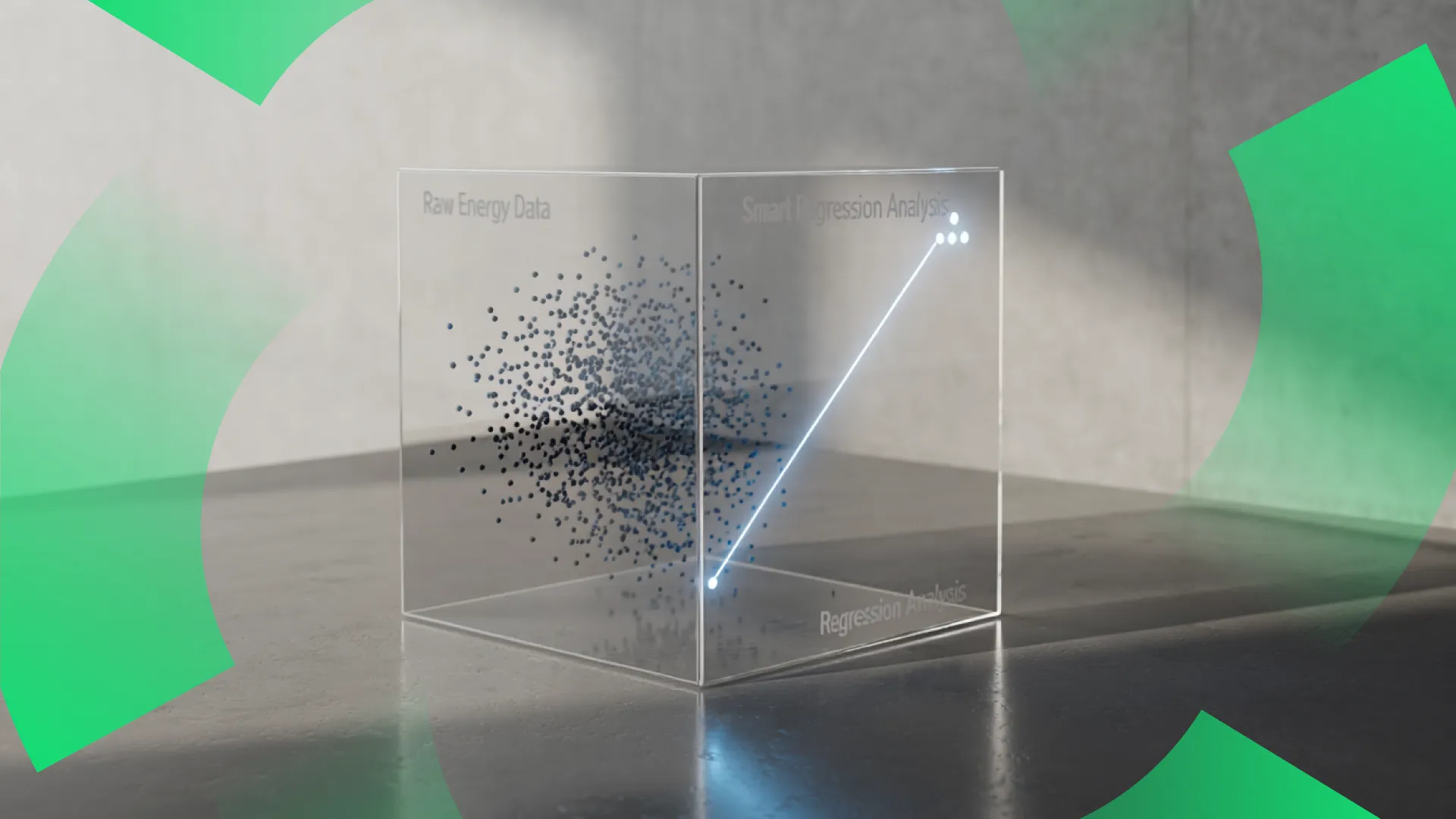
Even when data is available, comparing stores is nearly impossible without proper methodology. Comparing a store in a coastal city to one in a high-altitude inland location is structurally unsound. Comparing a mall store to a high-street store on the same metric produces misleading results.
Without normalizing for:
- Square footage
- Revenue per store
- Customer footfall
- Climate zone
- Store format
…what you get is not a measure of efficiency, but a distorted view of consumption.
The analysis generates noise, not insight.
The result: your organization can see that energy consumption and costs are rising. Finance sees the cost impact. Operations suspects inefficiency. The technical team points to aging equipment. But no one can clearly show which stores are underperforming or how large the efficiency gap actually is.
Data is present. Reference points are absent. Reports exist. Action does not follow.
Without benchmarking, energy performance remains impossible to maximize energy efficiency at scale.
Why This Problem Is Universal in Chain Retail
This is not a market-specific issue.
It is not limited to a segment, geography, or brand size.
This is the starting condition for most chain retailers.
Whether you operate 30 stores or 3,000, the underlying challenge is the same: energy data is fragmented, unstandardized, and disconnected from decision-making.
And it’s the condition that Apollo was built to resolve by making energy data structured, comparable, and actionable across every store.
What’s next
In Part 2: We’ll break down exactly why shopping mall stores and high-street stores require fundamentally different data approaches; and how proper segmentation unlocks the benchmarking that makes improvement possible.
Apollo is an AI-powered energy and sustainability platform trusted by 500+ organizations worldwide. FinWise, OptiWise, and EcoWise work together to deliver real-time visibility, operational benchmarking, and automated carbon accounting; all from a single platform.