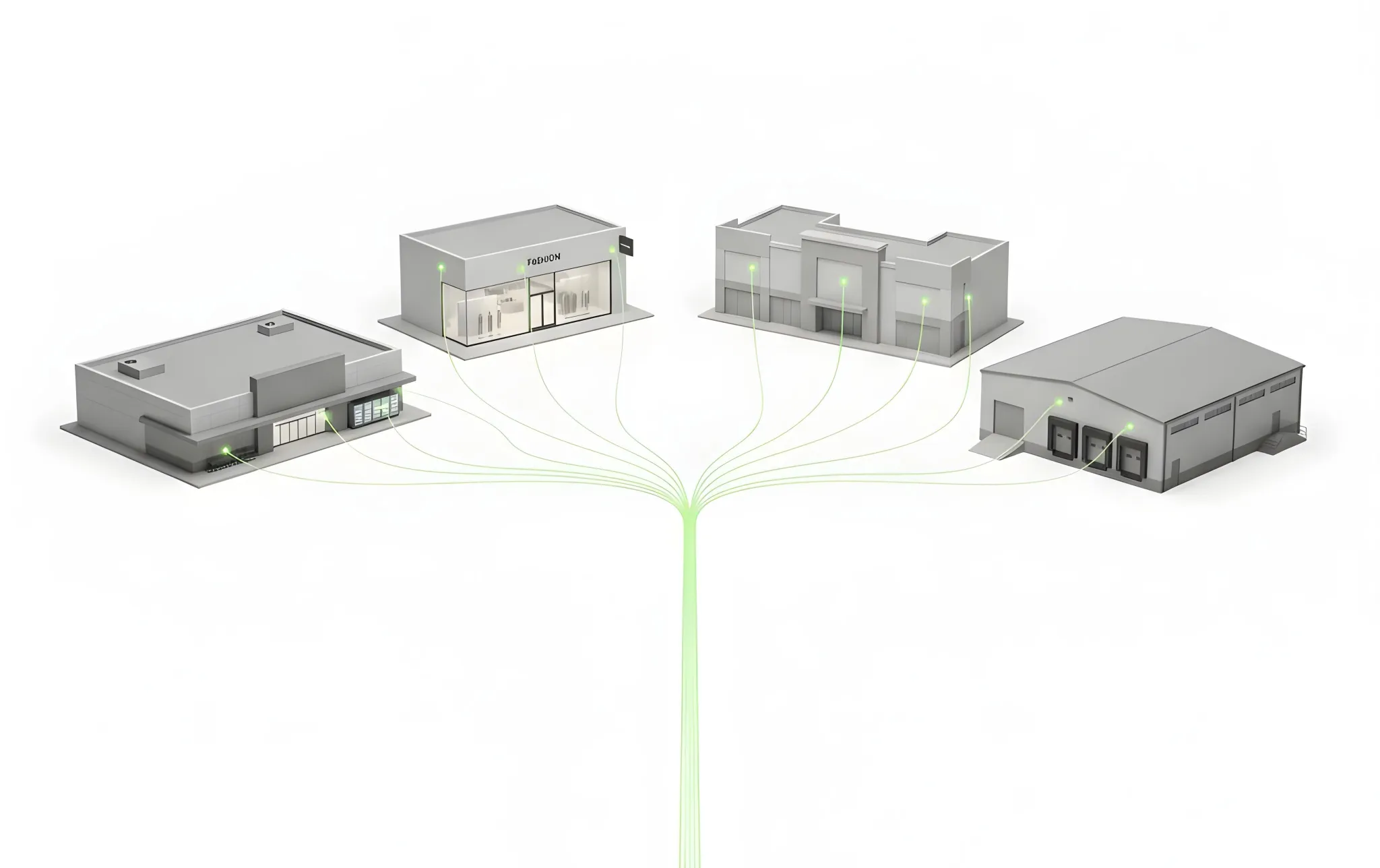
With every new store, supermarket, and warehouse, energy and sustainability management gets more complex. Apollo centralizes energy, cost, and carbon into a single intelligence layer for seamless optimization and cross-site benchmarking across every location.

8–17% of energy spend goes to waste. 6–11% of energy efficiency gains left on the table. And with every new store, the gap only widens; new meters, new tariffs, new bills, new efficiency variables, less visibility.
Scattered data across mall and street stores, different meters and different consumption patterns. Headquarters lacks a unified view. Cost control becomes reactive instead of strategic.
Up to 8% error rates in energy bills. Misaligned tariffs. Unbenchmarked unit prices. Reactive penalties. Even small inefficiencies compound significantly across hundreds of stores.
Two stores with similar size can consume vastly different amounts of energy. Refrigeration, HVAC, lighting; without normalization, performance comparisons are misleading.
Carbon reporting in retail is often manual and detached from real operational data. Operational teams lack ownership. Financial impact is unclear. Carbon goals exist but no one can measure progress against them.
The solution starts with unified, automated control. One platform that connects every store, benchmarks performance cross-site, and turns energy into a fully optimized cost line.
Monitor energy consumption and costs across every street store, mall store, and warehouse in real time. All data consolidated into one view, one source of truth for management.
Bill verification, tariff eligibility, unit price benchmarking, and reactive penalty tracking. All automated. Unnecessary energy costs prevented before they hit.
Every store normalized, benchmarked per m², and scored against other stores across the chain. Performance gaps of up to 500% become visible. Every energy efficiency project tracked with live ROI.
Automated Scope 1 and 2 carbon accounting from real energy data. Per-store, per-m², per-revenue emissions visible chain-wide. Targets tracked against actual performance.
Whether it’s a street store without a meter or a supermarket with full SCADA infrastructure, Apollo adapts. One platform that automates cost, efficiency, and carbon management across the entire retail chain.
Apollo gives retail chains full visibility into energy consumption, costs, efficiency performance, and carbon emissions from one platform. Every store format connected, every metric benchmarked cross-site, every action tracked with proven ROI.
8–17% energy cost waste in retail. Up to 8% billing errors. Up to 5% tariff savings. Reactive penalties compounding monthly. Across hundreds of stores, every missed optimization is lost margin.
Apollo Finwise provides full visibility and automates the entire cost control cycle across every store and warehouse.
Up to 500% energy performance gap between stores with similar size. Without normalization and m² benchmarking, most chains can’t see it; let alone fix it.
Apollo Optiwise normalizes, benchmarks, and scores energy efficiency of every store, then shows exactly where to improve first.
Most retail carbon reports are built on estimates and annual averages. Per-store, per-m², and per-revenue emission tracking across the entire chain is what turns compliance into competitive advantage.
Apollo Ecowise automates carbon accounting from real and AI-modeled consumption data across every store format.
From store-level actions to boardroom accountability. Every cost saving, efficiency gain, and carbon reduction measured, attributed, and reportable.
Apollo connects operational data to executive outcomes, making every energy decision visible and defensible.
What happens when every store is monitored, every bill is validated, and every efficiency gap is visible.
facilities managed with unified energy consumption and cost data
Energy cost advantage at Divan
energy costs saved last year through Apollo Finwise
Increase in operational efficiency at Medicana
energy efficiency improvement among Apollo OptiWise users last year
ROI at Domino’s Pizza
Real impact, measurable outcomes, and a energy strategy powered by clarity not guesswork.
“Apollo stood out as a single platform where we can track and control our energy costs and consumption across multiple facilities; one that's easy to use for everyone, from the technical team to procurement, and from procurement to the sustainability department.”
“We were able to see our company data in just a few days. Apollo identified the wrong electricity bills and also identified the great advantage on power factor correction.”
“The platform is intuitive, packed with features, and easy to use. We have been able to monitor energy data in real-time and forecast future costs as a result. Time and resources were also saved.”
Discover carefully selected content designed to complement what you’ve just read and inspire your next decisions.
Based on similar challenges and decision patterns, these solutions are often explored together.
Apollo connects to 500+ utility providers to pull real-time consumption data for street stores automatically. For mall stores without meters, Apollo’s AI model estimates consumption using HDD/CDD data, store m², format, operating hours, and same-mall reference data from metered stores. Where infrastructure already exists (Schneider, Siemens, ABB, SCADA, ERP/SAP), Apollo integrates seamlessly.
Energy bills across retail chains can carry error rates ranging from 8% to as high as 17%. Misapplied tariffs, duplicate charges, reactive penalties, and contract mismatches go undetected when validation is manual. Across hundreds of stores, even small errors compound into significant margin loss month after month.
Direct comparison between stores is misleading without normalization. A store in Madrid and a store in London face entirely different climate conditions. Apollo normalizes consumption using location-specific HDD and CDD data autonomously, then benchmarks every store per m². Additional variables like foot traffic and transaction count can be added via SAP integration or manual input. All stores are compared on equal terms, as if operating under the same conditions. Performance gaps of up to 500% between similarly sized stores surface instantly.
Yes. Apollo’s Optiwise benchmarks across street stores, mall stores, supermarkets, and warehouses using format-specific and sector-specific reference data. Each store is normalized by m², climate zone, operating hours, and format type. This means a 200m² mall clothing store is compared against similar mall clothing stores, not against a 2,000m² supermarket. Sectoral energy intensity benchmarks are also available, so chains can see how their portfolio compares to industry averages, not just internal performance.
Yes. Mall store invoices are collected through invoice parser, read with OCR, and normalized by AI. Apollo FinWise reverse-calculates invoices into consumption data and benchmarks the result per m². When a store’s consumption deviates from its benchmark band, Apollo generates an instant alert. This process works even without a physical meter; the combination of AI-powered parsing and m² benchmarking creates a reliable detection layer for overcharges, miscalculations, and anomalies across every mall location.
Apollo’s Optiwise tracks every initiative from energy efficiency investment to proven outcome. Each project is registered with target store, project type, and expected impact. The system continuously feeds real-time consumption data, unit energy prices, and operational variables into every project. Expected savings, actual savings, payback period, and before-and-after performance are updated dynamically. Leadership sees exactly which projects delivered results, which underperformed, and where to invest next.
See where energy and costs come from, how they evolve, and how to optimize them with confidence.