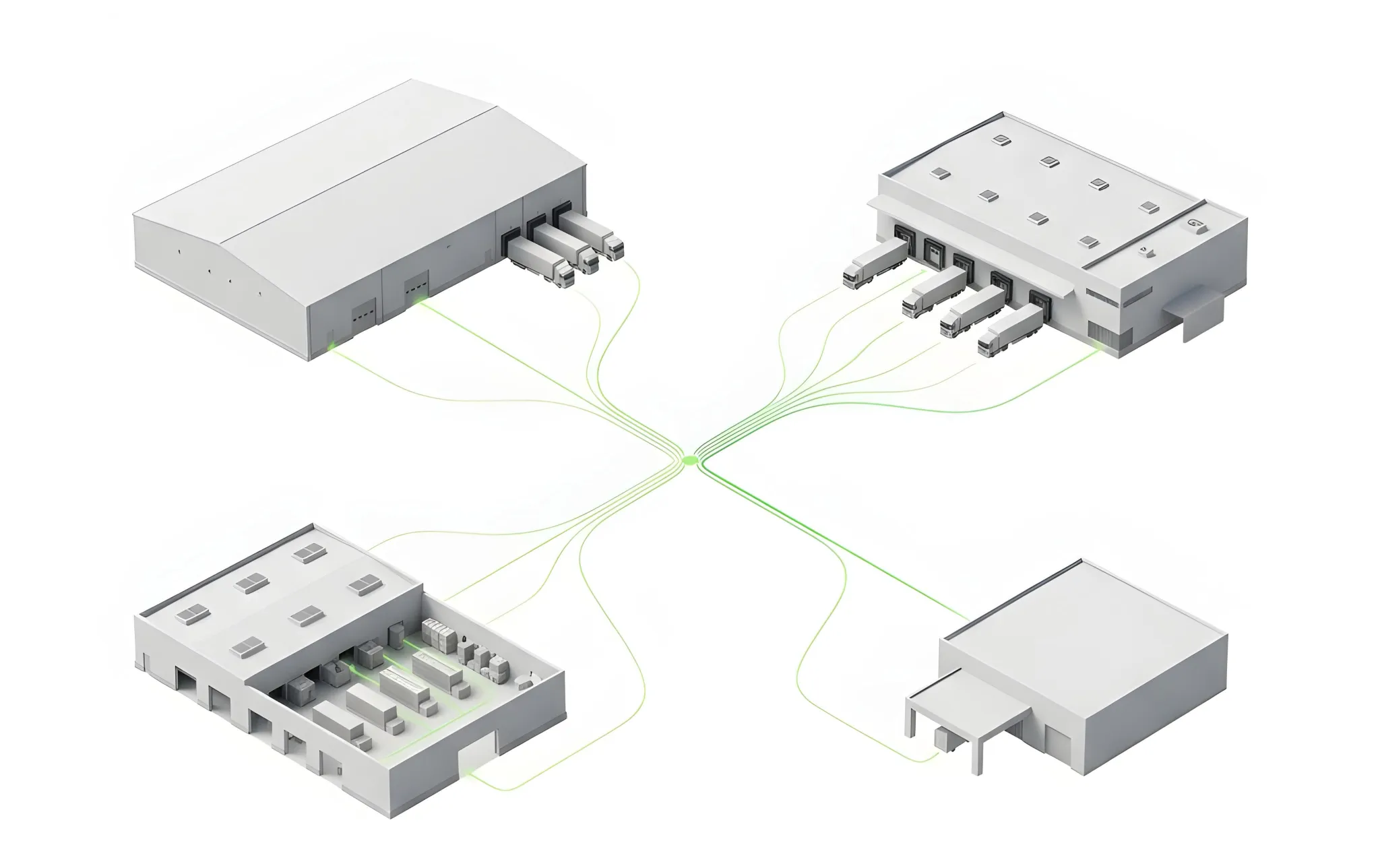
Apollo unifies energy, carbon, and operational costs across your entire logistics network. From cold storage to distribution centers, centralize every facility into a single intelligence layer for seamless multi-site optimization.
Energy accounts for up to 15% of logistics operating costs and up to 25% in cold storage. Every new facility deepens the gap; another meter, another tariff, another demand profile, another efficiency variable, another blind spot.
Fragmented cost and efficiency data across multiple facilities leave headquarters in the dark. Without a centralized view, identifying waste and maintaining operational efficiency across a multi-site network remains impossible.
Undetected invoice errors and misaligned industrial tariffs compound silently across massive logistics networks. In an industry where every cent counts, these hidden costs drain capital that should be fueling growth.
A cold storage site and an warehouse cannot be evaluated on the same terms. This lack of context masks operational failures, leads to misallocated CAPEX, and allows invisible energy waste to persist throughout the facility lifecycle.
Manual carbon tracking is detached from real-time facility data, leading to reporting delays and accuracy risks. Major clients and CSRD deadlines demand verified emissions data.
The solution starts with unified, automated intelligence. Centralize every facility, benchmark performance cross-site, and transform energy from an unpredictable overhead into a controllable financial and operational asset.
Stop managing operational silos. Centralize energy consumption data, utility invoices, and efficiency analysis into a unified platform. Achieve total visibility across thousands of locations and standardizes multi-site management.
By leveraging automated tariff optimization, demand charge management and invoice auditing, centralize multi-site cost management and protect operational margins against market fluctuations.
Performance normalized across the entire network using advanced intensity metrics (kWh/sqm/climate/other variables). High-performance facilities identified. Every efficiency project tracked with live ROI.
Automated Scope 1, 2, and 3 tracking across every facility. Per-shipment and per-facility emissions visible network-wide. Supply chain carbon mandates met without administrative overhead.
Whether it’s an ambient warehouse, a cold storage facility, or a multi-site distribution network, Apollo adapts. One platform that automates cost, efficiency, and carbon management across the entire logistics operation.
Apollo gives logistics leaders full visibility into energy consumption, costs, and efficiency performance across every node of the supply chain. From cold storage warehouses to distribution centers, every metric is benchmarked cross-site, with every operational action tracked for proven ROI.
Logistics companies lose millions to undetected invoice errors, misaligned industrial tariffs, and unmanaged demand charge spikes. Across facilities running 24/7, every missed optimization is capital lost.
Apollo Finwise automates the entire cost control cycle across every facility type.
Up to 500% energy performance gap between warehouses with similar size. Without normalization and m² benchmarking, most logistics networks can’t see it.
Apollo Optiwise normalizes, benchmarks, and scores energy efficiency of every facility, then shows exactly where to improve first.
Manual carbon tracking is detached from real-time facility data. Reporting delays, accuracy risks, and growing client mandates. The network can’t afford isolated ESG compliance.
Apollo Ecowise automates carbon accounting from real and AI-modeled consumption data across every facility.
From facility-level actions to boardroom accountability. Every cost saving, efficiency gain, and carbon reduction measured, attributed, and reportable.
Apollo connects operational data to executive outcomes, making every energy decision visible and defensible.
What happens when energy data becomes actionable.
facilities managed with unified energy consumption and cost data
Energy cost advantage at Divan
energy costs saved last year through Apollo Finwise
Increase in operational efficiency at Medicana
energy efficiency improvement among Apollo OptiWise users last year
ROI at Domino’s Pizza
Real impact, measurable outcomes, and energy strategy powered by clarity not guesswork.
“We've finally found a platform that delivers on its promises. Intuitive, comprehensive, and efficient, achieving our energy-saving goals faster than expected.”
“All data is more accessible, easier to understand, and easier to track, significantly simplifies operations across complex structures such as logistics and warehouse sector.”
“Apollo clearly and effectively presents real-time energy consumption data, providing valuable insights and future forecasts. The platform requires no initial setup or investment costs, making it easy to use without any technical expertise.”
Discover carefully selected content designed to complement what you’ve just read and inspire your next decisions.
Based on similar challenges and decision patterns, these solutions are often explored together.
Apollo Finwise integrates with existing metering infrastructure, IoT sensors, automatic meter reading (AMR/AMI) systems, SCADA, ERP/SAP, and utility providers across every facility type. Where smart meters or IoT devices are already deployed, Apollo pulls real-time data directly. For sites without submetering, Apollo’s AI model estimates consumption using operational variables like m², climate zone, operating hours, and facility type. Ambient warehouses, cold storage, and fulfillment centers; all connected from day one without additional hardware investment.
The fastest way to lower costs is through real-time monitoring together with automated bill validation and tariff optimization. By identifying billing errors and switching to the most cost-effective utility structures, logistics hubs can save up to 8–17% in energy expenses without installing new hardware.
Tracking requires normalization to ensure fair comparisons between different facility types. Using ISO 50001-aligned regression analysis, performance is benchmarked by $m^2$, $m^3$, or throughput (pallet movements), allowing headquarters to identify “dark spots” and waste across the entire network.
Heating and lighting account for approximately 76% of total energy consumption in non-refrigerated warehouses. In cold storage, refrigeration alone consumes up to 60% of electricity. Add forklift charging during peak demand hours, HVAC inefficiencies, and lighting in unoccupied zones; the waste compounds. Apollo identifies exactly where consumption deviates from expected performance and alerts teams before inefficiencies become cost.
Warehouses and distribution centers have ideal rooftop conditions for solar PV. Apollo tracks production, self-consumption, grid export, and net metering reconciliation end to end. Real-time solar ROI calculated automatically. Across a network of large-rooftop facilities, this visibility turns solar from a sustainability initiative into a measurable financial asset.
See where energy costs come from, how efficiency evolves, and how to optimize both with confidence.