


In colder climates, building HVAC is largely an additive task: push a measured amount of thermal energy into a space and hold it there.
In the Gulf, cooling is the opposite.
It is a continuous extraction problem fought against ambient temperatures that routinely exceed 45°C, with solar load striking facades and roofs from before sunrise. The thermodynamic work never stops, and neither does the cost.
That cost is not marginal.
More than 70% of energy consumption in UAE buildings is attributable to cooling, according to the Gulf Organization for Research and Development. For a hotel group, hospital network, mall operator, or industrial portfolio, that single category dominates the electricity bill.
That makes cooling cost optimization, not the lighting retrofit, the largest opportunity most operators have to reduce operating expense and Scope 2 emissions.
Here’s the thing though, the problem for most operators is not a lack of cooling capacity.
It is a lack of visibility into how efficiently that capacity is being used, across every site, every hour, against a cost structure that punishes waste and a regulatory regime that now demands the numbers.
How a One-Degree Thermostat Drift Inflates Cooling Costs
Start with the smallest possible error.
A thermostat set one degree lower than necessary raises cooling energy use by roughly 3% to 5% per degree, depending on the temperature differential the system is fighting.
In a temperate climate 1 degree is nothing and everything.
In a building extracting heat against a 45°C exterior, compressor load scales with that differential, so the penalty lands at the higher end of the range.
The reverse is just as real and is where the savings really are.
In one Abu Dhabi hotel study, raising the cooling setpoint produced a 9.28% drop in total building energy use and a 19.53% reduction in annual cooling load, with no capital expenditure at all.
Now multiply a single mismanaged degree across forty hotel floors, sixty retail units, or a hospital running 24 hours.
A setpoint that drifts unmonitored is an unhedged expense variable that compounds without anyone noticing, month after month, in thousands of dirhams that never appear as an obvious fault.
How DEWA Slab Tariffs Drive Up Commercial Cooling Costs
In Dubai, commercial consumption is billed on a slab tariff that climbs as you use more.
DEWA’s published rates run from AED 0.230/kWh for the first tier through AED 0.280, AED 0.320, and AED 0.380/kWh at the highest consumption band, before a quarterly fuel surcharge and 5% VAT are added on top.
The mechanism matters more than the headline numbers.
Because the rate rises with volume, every inefficient kilowatt-hour is billed at your marginal tier, not your average.
Waste is charged at the most expensive rate you reach. Cooling that runs unoptimized through the summer pushes the whole account into a higher pricing band, so the cost of inefficiency is steeper than a flat-rate calculation would suggest.
Peak demand compounds this.
Cooling load spikes hardest between roughly midday and early evening through the summer, exactly when ambient temperature and occupancy align. DEWA set new peak-demand records in 2025 against a backdrop of the warmest May in over two decades.
Plant that is not managed around those windows drives both consumption and the risk of crossing into the top tier at the worst possible time.
District Cooling Costs in the UAE: Capacity vs Consumption Charges
Many UAE commercial buildings do not run their own chillers at all.
They buy chilled water from a district cooling provider, and this is its own cost discipline. The UAE district cooling market was valued at roughly USD 3.7 billion in 2025 and is projected to reach USD 6.26 billion by 2033.
Empower alone holds more than 80% of Dubai’s connected cooling capacity, serving over 1,500 buildings; Tabreed dominates Abu Dhabi.
District cooling is billed on a two-part structure that catches operators out.
There is a consumption charge for the cooling you actually use (around AED 0.568 per refrigeration ton-hour with Empower) and a capacity charge for the peak capacity you have reserved (in the region of AED 700 to 850 per refrigeration ton, annually).
The capacity charge is the trap.
Many buildings reserve far more refrigeration tonnage than they ever draw, then pay for that headroom every year regardless of usage. Without interval data on actual versus contracted demand, that over-provisioning is invisible, and it is one of the largest recoverable costs in a district-cooled portfolio.
Why Your BMS Misses Multi-Site Chiller Efficiency Losses
Most enterprise buildings already run a Building Management System. The BMS does its mechanical job well: it keeps the building cold.
What it does not do is connect that mechanical behavior to financial consequence across a portfolio.
A standard BMS is local and operational. It reports that a chiller is running. It does not flag that the chiller is running 15% less efficiently than it did last quarter, that the cost of that drift is climbing the tariff slab, or that an identical site forty kilometers away is doing the same job for less.
The anomalies that erode margin tend to escape manual logsheets and fragmented spreadsheets entirely:
- Condenser fouling. A gradual film on condenser coils can cut chiller efficiency by up to 15%. It is invisible day to day and shows up only as a slowly rising bill.
- Refrigerant charge loss. A minor leak degrades the system’s coefficient of performance (COP), so the plant does the same cooling work for more electrical input.
- Scheduling drift. Air handling units running at full capacity in empty zones, or out-of-hours operation that no one is watching across shifts.
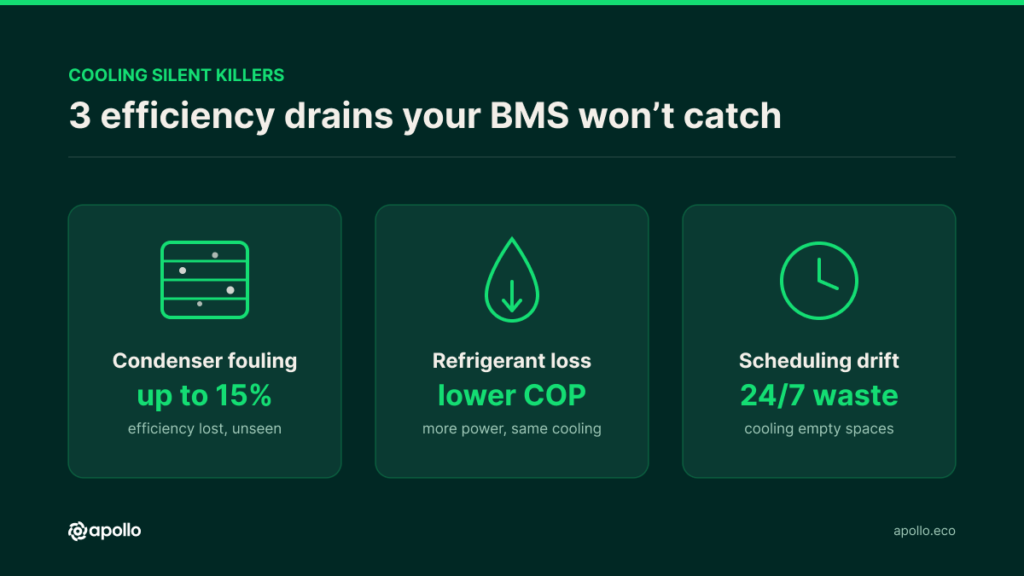
Each is small in isolation. Across a multi-site portfolio, in aggregate, they are a structural deficit hiding inside the largest cost category the business has.
What Cooling Cost Optimization Is Worth: Chiller Efficiency ROI
The discussion so far and beyond is far from theoretical. The retrofit and optimization literature for UAE and comparable climates is consistent and specific.
In the case study we mentioned before, improving a chiller’s COP from 2.5 to 3.0 in an Abu Dhabi hotel delivered meaningful savings on a payback of around five years. Demand limiting, chiller scheduling, and eliminating low temperature differentials save up to 15% of chiller energy.
System-level chiller plant optimization has demonstrated annual energy savings of 41% to 44% with an overall payback under three years.
The crucial point is that the highest-return measures are often operational, not capital.
Setpoint discipline, scheduling, and catching drift early cost little and pay back fast, but only if someone can see the inefficiency in the first place. That is a data problem before it is an engineering problem.
Using UAE Smart Meter Data (AMI) for Cooling Cost Optimization
Here is what makes the UAE different from many markets: the measurement layer is already built.
→ DEWA has reached effectively full smart-meter coverage across Dubai, with advanced metering infrastructure (AMI) capturing interval consumption data continuously.
→ EtihadWE has completed smart-meter installation across its customer base in the northern emirates, and Abu Dhabi’s distribution companies are moving the same direction under the UAE Energy Strategy 2050.
The data exists.
The problem is that it sits trapped behind utility portal logins, one account at a time, formatted for billing rather than operational decision-making. The interval telemetry that could expose every inefficiency the second it appears is being used, in practice, only to produce a monthly invoice.
Real cooling cost optimization means taking that automated meter data, combining it with the building’s own consumption and district-cooling signals, and streaming it into a processing layer that maps energy against tariff and asset performance in real time.
The instrumentation is in place but a monitoring layer is necessary.
UAE Climate Law: Cooling, Scope 2 Reporting, and Compliance
As of 2024, efficiency stopped being optional.
Federal Decree Law No. 11 of 2024 on the Reduction of the Effects of Climate Change makes the UAE the first MENA country to legislate corporate climate accountability. It entered into force on 30 May 2025, and the compliance deadline for entities was 30 May 2026.
All companies, including those in free zones, must now measure, report, and verify their Scope 1 and Scope 2 greenhouse gas emissions using the GHG Protocol. Failure carries fines from AED 50,000 up to AED 2 million.
For most enterprises, Scope 2 is dominated by purchased electricity, which is dominated by cooling.
That means the same interval data that controls cost is now also the raw material for a legally required emissions ledger.
Operators relying on manual spreadsheets to assemble that reporting are exposed on both fronts: They cannot optimize what they cannot see, and they cannot defend numbers they cannot trace.
Commercial Cooling Risks and Real-Time Fixes
Commercial Cooling Cost Optimization — UAE
Five hidden cooling risks draining your energy budget
Where multi-site enterprises lose money to cooling, and what real-time monitoring catches
How Apollo Enables Cooling Cost Optimization in the UAE
Apollo is built to be that intelligence layer, turning energy data into measurable cost, efficiency, and carbon outcomes on a single platform.
For the Gulf cooling problem specifically, three modules do the work:
Finwise maps interval consumption directly against UAE utility tariffs and district cooling structures, so slab-tier creep, peak-demand exposure, and over-reserved capacity become visible before the invoice arrives, not after.
Optiwise provides centralized, cloud-based asset monitoring and shift analysis across every site at once. Condenser fouling, COP decline, and out-of-hours runtime stop being things you discover during an annual audit and become anomalies you catch the week they start.
Ecowise converts those same cooling loads into audit-ready Scope 2 emissions data automatically, replacing fragmented spreadsheets with a defensible reporting lineage built for Federal Decree Law No. 11 compliance.
The thermodynamic battle against 45°C is not winnable in the sense of making it stop.
But the financial and regulatory deficit it creates is entirely manageable, because the data needed to manage it is already flowing. The question for any multi-site operator in the UAE is no longer whether the information exists.
It is whether anything is reading it. Let’s talk today.
Frequently Asked Questions
What is cooling cost optimization?
Cooling cost optimization is the use of interval energy and meter data to lower the cost of cooling, which drives over 70% of UAE building energy use, by catching inefficiency, managing DEWA tariff exposure, and cutting waste in real time rather than after the bill arrives.
How much of a commercial building’s energy use is cooling in the UAE?
More than 70%, according to the Gulf Organization for Research and Development. It is by a wide margin the largest controllable cost in the building.
How do DEWA slab tariffs work for businesses?
Commercial electricity is billed in rising tiers, from AED 0.230/kWh up to AED 0.380/kWh at the top band, plus a quarterly fuel surcharge and 5% VAT. Because the rate climbs with volume, inefficient consumption is billed at your highest marginal tier.
What is the difference between capacity and consumption charges in district cooling?
The consumption charge (around AED 0.568 per RT-hour) is for cooling you actually use. The capacity charge (roughly AED 700 to 850 per RT per year) is for the peak tonnage you reserve, whether or not you use it. Over-reserved capacity is a common hidden cost.
What is a good chiller COP, and what does improving it save?
Older plant often runs near a COP of 2.5; bringing it to 3.0 has shown meaningful savings on a roughly five-year payback in UAE conditions. Plant-level optimization can reach 40%+ energy savings with sub-three-year payback.
How much can raising the AC setpoint save?
In an Abu Dhabi hotel study, raising the setpoint cut total building energy use by about 9% and annual cooling load by nearly 20%, with no capital spend.
Does the UAE require companies to report carbon emissions?
Yes. Federal Decree Law No. 11 of 2024 requires all entities, including free-zone companies, to measure and report Scope 1 and Scope 2 emissions, with the compliance deadline on 30 May 2026 and fines up to AED 2 million for non-compliance.