


The UAE’s headline climate regulation has been in force since 30 May 2025. It applies to companies on the mainland and in free zones alike, it sets no size threshold, and it carries fines of up to AED 2,000,000.
Most of the companies it covers still do not know they are covered.
That is not carelessness. It is what happens when an obligation arrives before the instructions do. The compliance date in the UAE climate law was 30 May 2026. It passed. The technical guidance that would tell a company how to calculate and submit its emissions has still not been published.
So the question is no longer whether you missed a deadline. It is what the obligation actually requires, who it reaches, and what a company that has done nothing should do between now and the moment the guidance lands.
→ Who has to report, what exactly has to be reported, and what happens to a company that has not started?
Key takeaways
- The UAE Climate Law is Federal Decree-Law No. 11 of 2024. It entered into force on 30 May 2025 and applies to companies on the mainland and in free zones alike.
- It covers “Sources”, meaning any legal person or individual enterprise whose operations emit greenhouse gases. The Decree itself sets no size or emissions threshold, and readings differ on whether Scope 3 is caught, so treat Scope 1 and 2 as the floor.
- The compliance date was 30 May 2026. It has passed, and no revised date has been confirmed.
- Fines run from AED 50,000 to AED 2,000,000, and can double for a repeat violation within two years.
- Abu Dhabi is so far the only emirate with a live threshold: facilities at or above 25,000 tCO2e of Scope 1, reporting annually by 31 March, with independent verification required from 2027.
What is the UAE Climate Law?
The UAE Climate Law is Federal Decree-Law No. 11 of 2024 on the Reduction of Climate Change Effects, the federal instrument that makes measuring and reporting greenhouse gas emissions a legal obligation for companies operating in the United Arab Emirates.
It was issued on 28 August 2024, published in Official Gazette No. 782 two days later, and entered into force on 30 May 2025.
The law does two things at once. It requires covered entities to measure, record and report their emissions, and it requires them to contribute to reducing those emissions toward the country’s carbon neutrality commitment.
The reporting duty is the one with a date and a fine attached, which is why it gets the attention.
What the law does not do is settle the method, and this is where published readings of it diverge. Most law firm analyses, including those from PwC Middle East and Ropes & Gray, read the Decree as leaving scopes, boundaries, reporting periods, calculation standards and submission forms to implementing instruments issued by the Ministry of Climate Change and Environment (MOCCAE) or by an emirate-level authority. Some advisory summaries read Article 6 more broadly and describe it as already reaching Scope 3.
So what should you do exactly?
We would not plan around the broader reading until MOCCAE says so, but we would not dismiss it either. The practical position is that Scope 1 and Scope 2 are the floor, not necessarily the ceiling, and a company building an inventory now loses nothing by keeping value chain data in view.
That ambiguity, rather than the fine, is the real story of the past eighteen months.
Who has to report emissions under the UAE Climate Law?
The UAE climate law applies to “Sources”, which it defines as all public and private legal persons and individual enterprises whose operations release greenhouse gases into the atmosphere.
Read plainly, that is almost every operating company in the country. The Decree itself sets no size threshold, no activity list and no emissions floor. It leaves it to MOCCAE, or to a designated emirate authority, to determine which sources are called on to report and when.
This produces an uncomfortable position for a compliance team.
You are in scope by definition, but your obligation only becomes operative when you are designated. The safe reading, and the one most advisers have landed on, is to assume you are covered unless you can demonstrate otherwise, and to be ready rather than to wait.
What exactly does the UAE Climate Law ask you to do?
Four duties sit behind the headline.
1- Measure
Covered entities must quantify the greenhouse gas emissions arising from their activities in the UAE and maintain an emissions inventory.
2- Report
Reports go to MOCCAE or the relevant emirate authority, periodically, on approved forms, through an electronic system. Submission runs through the national MRV platform at mrv.ae, which hosts the Integrated Emissions Quantification Tool.
MOCCAE announced the national MRV system in October 2025 and the tool was presented at GITEX that month, though how much of the submission workflow is live for every designated entity is not something the published material settles.
3- Keep Records
Measured emissions data must be retained for at least five years and made available to the regulator on request.
4- Reduce
The law also obliges covered entities to contribute to emissions reduction through means it lists, including clean energy, carbon capture and offsetting. No reduction percentage and no timeframe has been set against this duty yet.
A separate instrument, Cabinet Resolution No. 67 of 2024, governs the National Register for Carbon Credits.
It requires annual Scope 1 and Scope 2 reporting calculated under the GHG Protocol and audited by an ISO 14065 accredited, MOCCAE-authorized verifier. Its obligations bite at the top of the market, above 0.5 million tonnes of CO2e a year, and should not be confused with the Decree’s general reporting duty.
When was the deadline, and did it move?
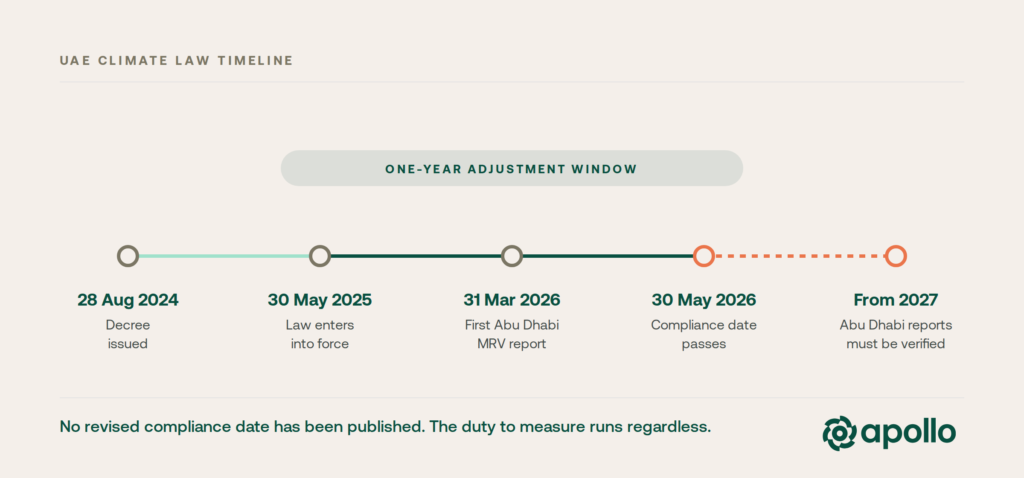
| Date | What happened |
|---|---|
| 28 August 2024 | Federal Decree-Law No. 11 of 2024 issued, published in Official Gazette No. 782 on 30 August |
| 30 May 2025 | Law enters into force. The duty to measure and retain emissions data becomes live |
| October 2025 | MOCCAE announces the national MRV system; the Integrated Emissions Quantification Tool is presented at GITEX |
| 31 March 2026 | First Abu Dhabi MRV reporting deadline, covering calendar year 2025 |
| April 2026 | MOCCAE indicates the federal date may be extended pending technical guidance |
| 30 May 2026 | Compliance date in the law passes. No revised date confirmed, no technical guidance published |
| 2027 | Independent verification becomes mandatory for Abu Dhabi reports covering year 2026 |
The compliance date written into the UAE climate law was 30 May 2026, one year after entry into force. It is widely described as the Article 18 transition period, a one-year window for entities to bring themselves into line.
We should be straight about the sourcing here: that reading is consistent across advisers and we have no reason to doubt it, but the government’s legislation register publishes the Decree’s metadata rather than its articles, and the Arabic text is the authoritative version. If the article number matters to a decision you are taking, read it there rather than taking it from us.
MOCCAE representatives indicated in April 2026 that the date was likely to be extended once technical guidance was issued.
As of today, no revised date has been confirmed and no extension has been formally published. The original date has passed.
Why could nobody actually comply on time?
Because the mechanics were not there. An obligation is only as real as the method that lets you discharge it, and for the twelve months of the adjustment window there was no published MOCCAE methodology, no defined reporting boundary, no confirmed submission date, and no designation list telling a company whether it was called.
Companies that tried to prepare anyway did the only thing available: they built Scope 1 and Scope 2 inventories on ISO 14064 or the GHG Protocol and waited to be told whether that would be accepted.
This is worth stating plainly rather than treating as a loophole.
The duty to measure and retain data has been live since May 2025 regardless of guidance. What is uncertain is the format and the date of submission, not whether the underlying data has to exist. A company that has no inventory is not waiting on MOCCAE. It is behind on something it could have started last year.
What are the penalties for not reporting?
Breaching the measurement, reporting and recordkeeping requirements carries administrative fines of AED 50,000 to AED 2,000,000. A repeat violation within two years of a final decision can double the penalty.
The tiering under the carbon credit register resolution runs up to AED 500,000 for a first violation, AED 1,000,000 for a second and AED 2,000,000 for subsequent ones. A further Cabinet resolution setting out the full administrative penalty schedule under the Decree is still expected.
In practice, enforcement so far has looked like notices and corrective deadlines rather than fines. That is normal for a regime whose guidance is incomplete, and it is not a reason to assume the numbers are decorative.
Do free zone companies have to report to the UAE Climate Law?
Yes. The law applies to all emissions sources in the UAE, and free zones are explicitly included.
This catches a lot of companies off guard, because free zone entities are used to a regulatory perimeter that sits with their own authority. Climate reporting does not work that way here. The obligation is federal, and a free zone licence does not remove it.
Is the UAE Climate Law a federal obligation or an emirate one?
Both, and the split is where most of the practical confusion lives.
The Decree is federal. But it lets emirate-level authorities designate sources and set thresholds within their own jurisdiction, and so far Abu Dhabi is the only emirate to have done so.
The Environment Agency Abu Dhabi runs an MRV programme that applies to facilities emitting 25,000 tonnes of CO2e or more in Scope 1 in the previous calendar year, across industry, power, oil and gas, and transport.
Reports are due annually by 31 March, filed per facility. Facilities below the threshold still have to submit one year of data to confirm their status, after which they need not report again unless they cross the line in a later year. From 2027, covering reporting year 2026, those reports must be independently verified by an ISO 14065 accredited verifier, with EAD expected to publish an annual list of accredited verifiers.
One number to be careful with: Some secondary coverage has reported the Abu Dhabi threshold as 500,000 tonnes.
That figure belongs to the National Register for Carbon Credits under Cabinet Resolution No. 67 of 2024, not to the MRV programme. The MRV threshold is 25,000, a factor of twenty lower, and a facility reading the larger number would wrongly conclude it is out of scope.
The programme is not theoretical. Reporting on its first cycle in January 2026, EAD said it had collected emissions data from more than 250 companies covering roughly 90 million tonnes of CO2e, about 80 percent of the emirate’s major emitting activities.
The result is an uneven map.
A group with a facility in Abu Dhabi has a dated, specific, verifiable obligation. The same group’s operations in another emirate have a federal duty with no operative emirate route attached to it yet.
What should a company that has done nothing do now?
Build the inventory anyway
Twelve months of Scope 1 and Scope 2 data at facility level, from utility bills, fuel records and production logs. No guidance is needed to start this and none will change what the underlying numbers are.
Pick a methodology and write it down
ISO 14064 or the GHG Protocol. What matters when guidance lands is that your figures came from a stated method rather than from an estimate nobody can reconstruct.
Find out whether you have been designated
Check with MOCCAE and with the authority in each emirate where you operate. A group can be designated in one emirate and silent in another.
Register on the platform before you need it
Access to mrv.ae runs through an organisation administrator and an emirate focal point approval. That is a queue, not a form, and it is better cleared early.
Make the data verifiable, not just available
Abu Dhabi requires independent verification from 2027. Anything an ISO 14065 verifier will have to trace should already be traceable now, while it is cheap to fix.
How does an energy intelligence platform make this reportable?
The reporting problem under this law is not really a reporting problem. It is a measurement problem that only shows up at reporting time, when someone asks for a figure that can be traced back to a meter rather than to a spreadsheet.
→ Optiwise turns consumption across sites into one comparable picture, so a facility-level inventory is a query rather than a project.
→ Finwise keeps the cost side of the same dataset honest, which is what makes the measurement worth funding before the fine exists. It is also where the overlap with energy costs in the UAE stops being a coincidence.
→ Ecowise converts that consumption record into Scope 1 and Scope 2 figures with a lineage you can show a verifier, which is exactly what both the federal duty and the Abu Dhabi programme ask you to stand behind.
None of this makes the guidance arrive sooner. It does mean that when it does, the answer is already in the system rather than in twelve months of invoices nobody has opened.
Let’s talk.
Frequently asked questions
What is the UAE Climate Law?
It is Federal Decree-Law No. 11 of 2024 on the Reduction of Climate Change Effects. It entered into force on 30 May 2025 and makes measuring, recording and reporting greenhouse gas emissions a legal obligation for companies operating in the UAE, including in free zones.
Who has to report emissions in the UAE?
The law defines covered entities as “Sources”, meaning public and private legal persons and individual enterprises whose operations emit greenhouse gases. It sets no size or emissions threshold of its own, leaving designation to MOCCAE or an emirate authority. In Abu Dhabi, facilities emitting 25,000 tonnes of CO2e or more in Scope 1 are already in scope through the Environment Agency’s MRV programme.
What was the UAE emissions reporting deadline?
The compliance date in the law was 30 May 2026, one year after entry into force. MOCCAE signaled in April 2026 that it might be extended pending technical guidance, but no revised date has been confirmed.
What are the penalties under the UAE Climate Law?
Administrative fines run from AED 50,000 to AED 2,000,000 for breaches of the measurement, reporting and recordkeeping duties, and can double for a repeat violation within two years of a final decision.
Do free zone companies have to comply?
Yes. The law covers all emissions sources in the UAE and names free zones explicitly. A free zone licence does not remove the federal obligation.