CBAM stopped being a reporting exercise on January 1, 2026. The transitional period, when importers filed quarterly reports and paid nothing, ended on December 31, 2025.
A lot of what’s written about CBAM still describes that period. So it’s worth being precise about what replaced it, because the obligations now come with a price per tonne and a status you can’t get after the fact.
And the scope is still moving. Parliament and Council negotiators held the first trilogue on extending CBAM to downstream products on October 20, 2026. The next round is set for November 30.
→ What does CBAM require in 2026, when do you pay, and how much of your emissions are you paying for?
|
Key takeaways
|
What is the Carbon Border Adjustment Mechanism (CBAM)?
The Carbon Border Adjustment Mechanism is the European Union’s carbon price on imports of certain carbon-intensive goods. An EU importer buys and surrenders CBAM certificates for the greenhouse gas emissions embedded in what it brought in, at a price tied to the EU’s own carbon market.
Its purpose is narrower than most descriptions suggest. It’s not an environmental tax and it’s not a tariff. EU producers pay for their emissions under the EU Emissions Trading System, importers didn’t, and that gap gave companies a reason to move production outside the EU instead of cutting emissions. CBAM puts the imported tonne and the domestic tonne on the same footing.
It ran as a reporting-only transitional period from October 1, 2023 to December 31, 2025. Nothing was paid. That phase is over, and the definitive regime has applied since January 1, 2026.
Which goods does CBAM cover?
Six sectors, defined by customs code rather than by industry label: cement, iron and steel, aluminum, fertilizers, electricity and hydrogen.
Two things trip people up here. The list is of goods, so a manufacturer who has never thought of itself as a steel business can still import steel components that fall inside it. And the codes are granular enough that two similar products can end up on opposite sides of the line.
The scope is being widened. In December 2025 the Commission proposed extending CBAM to about 180 downstream product types, mostly steel- and aluminum-intensive goods, with the new scope applying from January 1, 2028. The Council adopted its position on June 12, 2026 with a longer list. Parliament’s mandate, voted on September 15, 2026, covers 457 products and goes further in other places too.
The first trilogue didn’t settle much, which is normal for a first round. According to Agence Europe’s report, both sides presented their mandates and sent the harder questions to technical work: a threshold for aluminum products, the treatment of metal scrap, whether online platforms are covered, and default values at global level. The second trilogue is provisionally set for November 30, and the Council has said it wants a deal before the end of the year.
None of this is law yet. If your goods are steel- or aluminum-intensive but out of scope today, this is the file to watch. And 2028 is closer than it sounds when supplier data takes the better part of a year to build.
Who has to report, and what is an authorized CBAM declarant?
The obligation sits with the importer established in the EU, not with the producer abroad. In our conversations with exporters, this is the misunderstanding that comes up most. A Turkish steel mill or an Indian fertilizer plant doesn’t register with the EU. Its European customer does, and then comes asking the mill for data.
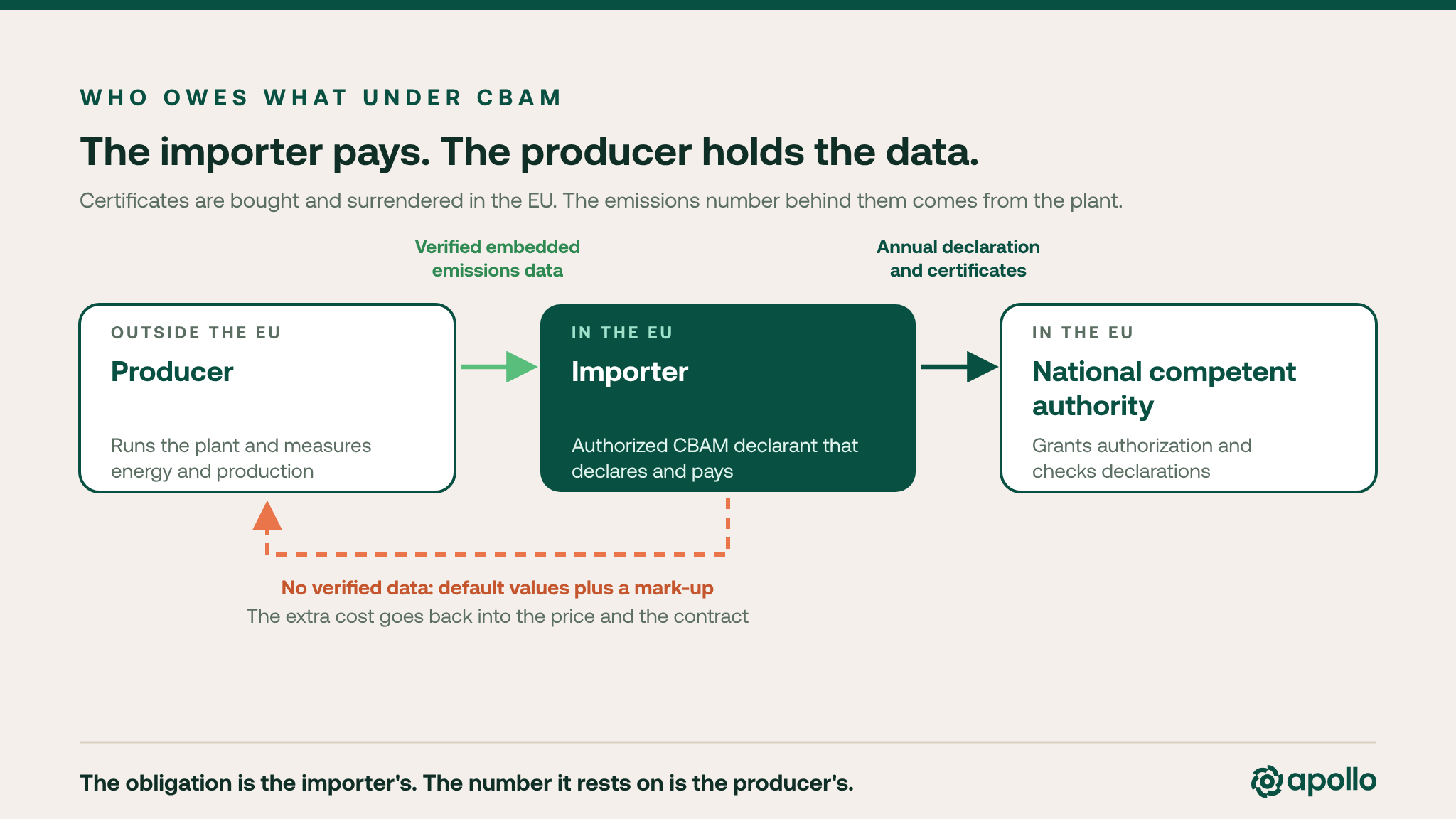
Under the definitive regime, importing CBAM goods above the threshold requires authorized CBAM declarant status, granted by the national competent authority in the Member State where the importer is established. Importers that applied by March 31, 2026 could keep importing while their application was processed. That window has closed, so anyone approaching the threshold now has to apply before the shipment that takes them over it.
Two features of the status matter commercially. You can’t get it at the border, and it isn’t backdated. Losing it, which is one of the consequences of serious or repeated non-compliance, means losing the right to import those goods at all. For most importers that’s a sharper tool than a fine.
What is the 50 tonne threshold, and does it get you out?
The definitive regime introduced a mass-based threshold of 50 tonnes per importer per year, cumulative across cement, fertilizers, iron and steel, and aluminum. Below it, the CBAM obligations don’t apply.
When the threshold was designed, the Commission estimated it would take about 90 percent of importers out of scope while still capturing about 99 percent of embedded emissions. Its first review, published September 30, 2026, found that the threshold exempted 0.87 percent of embedded emissions between April 2025 and March 2026, under the 1 percent ceiling the regulation sets. So 50 tonnes stays for now. Nine of those twelve months fall in the transitional period, though, so the next review will say more.
Electricity and hydrogen get no relief. Importers of either must always be authorized declarants, whatever the volume.
The threshold counts the whole year across every shipment. An importer bringing in five tonnes a month is past it by November.
When do you actually pay?
| Date | What happens |
|---|---|
| October 1, 2023 | Transitional period begins. Quarterly reporting only, nothing payable |
| December 31, 2025 | Transitional period ends |
| January 1, 2026 | Definitive regime begins. Authorization needed above the 50 tonne threshold |
| March 31, 2026 | Last day to apply and keep importing while the application was processed |
| October 20, 2026 | First trilogue on the downstream extension |
| November 30, 2026 | Second trilogue on the downstream extension (provisional) |
| January 4, 2027 | Fourth-quarter 2026 certificate price published |
| February 1, 2027 | CBAM certificate sales open |
| September 30, 2027 | First annual declaration and certificate surrender, covering 2026 imports |
| January 1, 2028 | Proposed start of the downstream extension |
The gap between import and payment is the part to plan around. Emissions from 2026 imports aren’t paid for until 2027. A year of imports builds up a liability that doesn’t show up on a bill until the following fall, and that’s a long time to carry a cost nobody has counted.
The first declaration deadline also moved. It was originally May 31, 2027, and the 2025 simplification regulation pushed it to September 30, 2027. Older guidance still carries the earlier date.
What does a CBAM certificate cost?
For 2026, the Commission publishes one price per quarter: the volume-weighted average of EU ETS auction clearing prices in that quarter, published in the first week after it ends. Three are out so far. The first and second quarters came in at around 75 euros per tonne of CO2e, and the third, published October 5, at around 82. The fourth-quarter price is due January 4, 2027. From 2027 the price moves to a weekly average.
Each 2026 import is priced at the quarter it arrived in, even though the certificates aren’t bought until 2027. That means three quarters of the 2026 price are already known, and the 2026 CBAM factor is fixed in law. The number still open is your embedded emissions.
How much of your embedded emissions do you pay for?
Not all of them, at least not yet. The CBAM factor sets the share of embedded emissions that needs certificates in a given year. It rises as free allocation to EU producers under the ETS is phased out.
| Year | CBAM factor | What it means |
|---|---|---|
| 2026 | 2.5% | Certificates cover 2.5 percent of embedded emissions |
| 2027 | 5% | Weekly certificate prices and the 50 percent quarterly holding begin |
| 2028 | 10% | Default value mark-up reaches 30 percent |
| 2029 | 22.5% | The curve steepens here |
| 2030 | 48.5% | Roughly half of embedded emissions |
| 2031 | 61% | More than half of embedded emissions |
| 2032 | 73.5% | About three quarters of embedded emissions |
| 2033 | 86% | Last year with any free allocation |
| 2034 | 100% | Free allocation fully phased out |
The low factor in the early years is a ramp. The data obligation already applies in full.
So for a 2026 import, you’re paying for 2.5 percent of the embedded emissions, at the price of the quarter it arrived in. By 2030 that’s close to half.
From 2027 there’s a holding requirement as well. At the end of each quarter, declarants have to hold certificates covering at least 50 percent of the embedded emissions imported since the start of the year. The simplification package cut that from 80 percent. What you owe at year end stays the same. The difference is how much cash sits in certificates in the meantime.
How are embedded emissions calculated?
Two routes, and the difference between them is money.
Actual values come from the producer’s own monitored data and have to be checked by an accredited verifier. Default values apply when actual data isn’t available, and they’re set on the cautious side on purpose. A system that rewarded not measuring wouldn’t work.
On top of that, default values now carry a mark-up: 10 percent in 2026, 20 percent in 2027 and 30 percent from 2028, with a much lower rate for fertilizers, according to the Commission’s CBAM questions and answers. The cost of not measuring grows every year.
The result is simple. A producer who can’t evidence its actual emissions is priced on a deliberately unfavorable assumption, however efficient the plant really is. An efficient plant with no measurement pays like an inefficient one. If you’re building that measurement from scratch, our carbon footprint calculation guide covers the inventory side.
That’s also why the data chain has to be built with the buyer, and early. The declaration is the importer’s legal obligation, but the data belongs to the producer, and the format needs to be agreed well before fall 2027.
Can a carbon price paid at home be deducted?
In principle, yes. The regulation lets a carbon price already paid in the country of origin be set against the CBAM obligation, so the same tonne isn’t charged twice.
In practice, the route to claiming it isn’t finished. The Commission published a draft implementing act on May 13, 2026, and the consultation closed on June 10. As of late October 2026 it still hasn’t been adopted. The draft counts the price actually paid, after free allocation, rebates and exemptions are taken off, and it only applies to goods declared with verified actual emissions.
Türkiye shows why that detail matters. Its ETS pilot covers 2026 and 2027 emissions. 2026 is a reporting-only year, allocation is 100 percent free on a benchmark basis, and a price mechanism is due to start from the 2027 system year, according to the Climate Change Presidency. With allocation fully free, most pilot-phase emissions won’t carry a paid price, and a deduction can only be as large as what was actually paid.
Until the act is adopted, nobody exporting into the EU should budget for a deduction. It exists in the regulation. The way to claim it doesn’t exist yet.
What should an importer or exporter do now?
| Five moves before September 2027 | |
| 01 | Check whether you’re over 50 tonnes Annual and cumulative across the four threshold sectors, by customs code rather than by supplier. Electricity and hydrogen need authorization at any volume. |
| 02 | Get authorized before you cross the line Status comes from your national competent authority and isn’t backdated. The March 2026 grace window has closed, so apply before the shipment that takes you over. |
| 03 | Decide actual versus default, per supplier Where verified actual data isn’t achievable, price the default value and its mark-up into the contract now, instead of finding it in September 2027. |
| 04 | Build the data chain with your suppliers Energy and production data at product level, in one agreed format, measured continuously enough for a verifier. Plan on months of work. |
| 05 | Watch the downstream file If your goods are steel- or aluminum-intensive, the November 30 trilogue could decide whether you’re in scope from 2028. Plan for the possibility before the announcement. |
How does an energy intelligence platform make this reportable?
The hard part of CBAM is producing a per-product emissions figure a verifier will accept, from plants that measure energy at site level and production at line level and have never had to join the two.
→ Optiwise turns consumption across sites, lines and equipment into one comparable picture, which is the layer underneath any product-level emissions figure.
→ Finwise keeps the cost side of the same dataset visible, so the carbon liability and the energy bill are read from one source.
→ Ecowise converts that record into emissions figures with a lineage you can hand to an accredited verifier, which is what the gap between actual and default values comes down to.
The CBAM factor for 2030 is already written into law, and no software moves it. A measured, verified emissions number per product is the part you control.
Let’s talk.
Frequently asked questions
Is CBAM a tax or a tariff?
Legally, it’s a certificate obligation. A tariff is a duty on the value of a good and a tax goes into general revenue. CBAM requires importers to buy and surrender certificates priced off the EU carbon market, in a quantity set by the emissions embedded in the goods. That distinction is how the EU argues CBAM is a carbon leakage measure rather than a trade barrier, and several trading partners dispute it.
Do exporters outside the EU have to register for CBAM?
No. The declarant is the importer established in the EU. A producer in Türkiye, India or the Gulf has no EU registration duty. What it has instead is a customer who can’t complete a declaration without its data, and commercially that’s a stronger obligation than registering would be.
How much does a CBAM certificate cost in 2026?
The Commission publishes one price per quarter for 2026, based on EU ETS auction prices. The first three quarters came in at around 75, 75 and 82 euros per tonne of CO2e. The fourth-quarter price is due January 4, 2027, and from 2027 prices are published weekly.
When will CBAM cover downstream products?
Not before 2028. The Commission proposed applying the extension from January 1, 2028. Parliament and Council opened trilogue negotiations on October 20, 2026 and are due to meet again on November 30. Until a final text is adopted, the product list isn’t settled.
What happens if you import above the threshold without authorized declarant status?
You’re non-compliant from the shipment that takes you over, and the status can’t be backdated. National authorities can impose penalties, and serious or repeated breaches can lead to the status being revoked, which ends the right to import those goods. For an importer whose production depends on them, that’s the more serious of the two.