



When your organization spends money to use less energy, one question follows every project: did it actually work, and can you prove it?
And there is an awkward truth buried inside that number. You cannot directly measure energy you did not use. A saving is an absence, and an absence has to be proven, not simply read off a meter.
That proof is the job of measurement and verification.
I have seen strong efficiency projects lose credibility because the savings could not be defended to finance or an auditor because the savings could not be defended, and modest ones sail through because the measurement and verification was watertight.
This is a practical guide to doing M&V right:
What it is, why it protects your budget and your reporting, the frameworks that govern it, and the habits that separate a defensible savings number from a guess.
- Measurement and verification (M&V) proves energy savings are real by comparing an adjusted baseline to actual reporting-period use. The saving is avoided energy, not a meter reading.
- For any organization paying for efficiency, M&V is how you confirm savings are real and defend them to finance, auditors and regulators, and how you check what an ESCO or utility bills you.
- The frameworks that matter are IPMVP (options A, B, C and D), ASHRAE Guideline 14, and ISO 50015.
- Credible M&V rests on a defensible baseline, honest treatment of non-routine events, and quantified uncertainty.
- Verified savings now feed compliance too: ISO 50001 EnPIs, CSRD reporting, and CBAM-grade emissions data.
What is measurement and verification (M&V)?
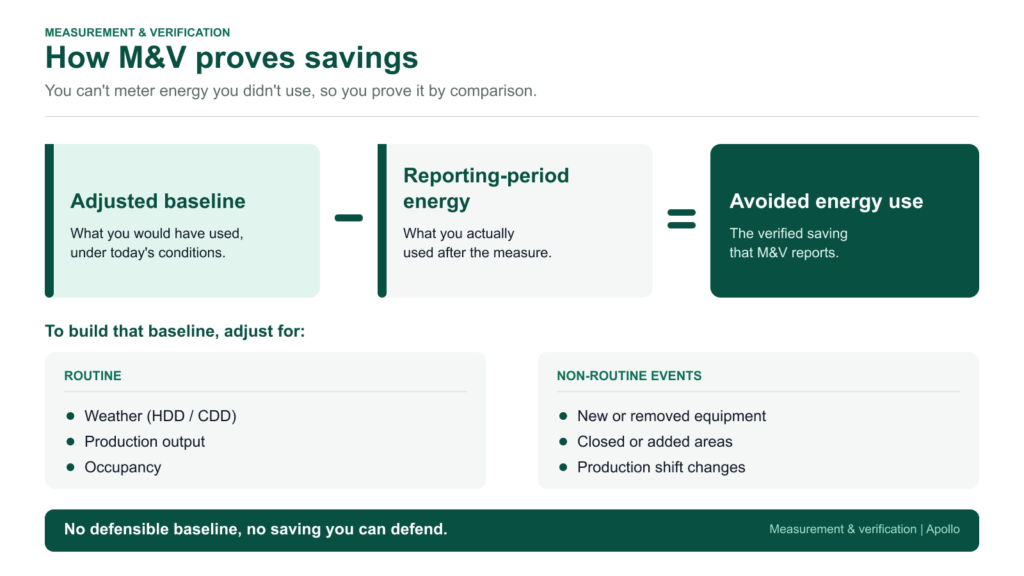
Measurement and verification is the structured process of quantifying the savings delivered by an energy efficiency measure. Because you can never meter the energy a project stopped you from using, M&V works by comparison: it builds a baseline of what energy use would have been, adjusts that baseline to the conditions of the period after the project, and subtracts actual use. What remains is the saving, often called avoided energy use.
The subtlety, and where most of this operation goes wrong, is the word “adjusted.”
You cannot simply compare last year’s bill to this year’s, because weather, production, and occupancy all change.
A proper baseline is corrected for those factors so you are comparing like with like.
| Term | What it means |
|---|---|
| Adjusted baseline | The energy the site would have used under reporting-period conditions, without the measure. |
| Reporting period | The time after the measure, when performance is tracked. |
| Avoided energy use | The saving: adjusted baseline minus reporting-period energy. |
| Measurement boundary | What is included in the analysis: one system, or the whole facility. |
| Routine adjustment | A correction for expected variables such as weather and production. |
| Non-routine event (NRE) | An unexpected change (new equipment, occupancy shift) that must be adjusted for. |
| Uncertainty | How confident you can be in the reported savings number. |
| M&V plan | The document defining method, boundary, baseline and reporting, agreed up front. |
Why does M&V matter for your organization?
If you run a multi-site operation, energy efficiency is now a line in your capital plan, and every project has to earn its place. Measurement and verification is how you prove it did.
It turns an engineering change into a number your CFO can bank, your auditor can accept, and your board can trust. The same logic governs any energy performance contract you sign:
When an energy service company (ESCO) is paid out of the savings it delivers, M&V is the referee, so you should never accept a contract whose M&V you cannot verify yourself.
Beyond contracts, the same discipline serves a wide audience.
Inside the enterprise, the same discipline serves everyone who touches energy. Energy and facilities teams prove gains against ISO 50001 indicators. Sustainability teams substantiate disclosures.
Finance teams check that savings, and supplier invoices, actually add up. What they share is a need that has only grown sharper in 2026: numbers that survive scrutiny.
Estimates and unadjusted spreadsheets no longer pass. Robust measuring and verifying is what turns a claim into an asset.
I once watched a company get billed for savings that never accounted for the data room it had installed mid-year.
The efficiency work was fine, but there was no clean baseline and no non-routine adjustment clause, so nobody could say what the real saving was. Without its own measurement and verification, the client had no way to challenge the number.
That single gap is the whole game.
How does M&V actually prove savings?
The logic is simple to state and easy to get wrong. You model a baseline, adjust it to reporting-period conditions, and compare. The gap is your saving.
Routine adjustments handle the predictable drivers: heating and cooling degree days for weather, output for production lines, occupancy for buildings.
Non-routine adjustments handle the surprises, a new production shift, a wing that was closed, a chiller that was added, anything that changes energy use for reasons unrelated to your measure.
Miss a non-routine event and your savings number is wrong, sometimes in your favor, sometimes not. If you measure and verify right, it treats these adjustments as the main event, not an afterthought.
The final piece is uncertainty.
Every savings figure carries error from measurement, from sampling, and from the model itself, and pretending it does not is how disputes begin. Strong M and V reports the saving as a value with a confidence range, so everyone knows how much weight the number can bear.
A smaller, honest figure beats a larger one nobody can defend.
What are the four IPMVP options?
The International Performance Measurement and Verification Protocol (IPMVP), maintained by the Efficiency Valuation Organization, is the global backbone of the field.
It defines four options, and choosing the right one for the measure and the contract is half the battle.
| Option | Approach | Best for |
|---|---|---|
| A | Retrofit isolation, key parameter measured, others estimated | Single measures with predictable factors; lower cost |
| B | Retrofit isolation, all parameters measured | Single systems needing full rigor and higher accuracy |
| C | Whole facility, utility-meter regression | Multiple or whole-building measures; sensitive to non-routine events |
| D | Calibrated simulation | New builds or projects with no usable baseline data |
As a rule of thumb, the more that rides on the number, the more measurement you can justify.
A single lighting retrofit rarely warrants Option B metering; a multi-site capital program or a large performance contract usually does.
Which standards govern measurement and verification?
IPMVP sets the framework, but it does not stand alone. Three references work together, and knowing which does what keeps your verification and measurement defensible when an assessor arrives.
| Standard | What it is | What it is for |
|---|---|---|
| IPMVP | The global M&V framework (EVO) | Defines options, terms, and the M&V plan |
| ASHRAE Guideline 14 | Statistical and engineering criteria | Regression models and uncertainty thresholds |
| ISO 50015 | The organizational M&V standard | M&V of enterprise energy performance |
| ISO 50006 | Baselines and indicators | Setting EnBs and EnPIs, pairs with ISO 50001 |
How does M&V support ISO 50001, CSRD and CBAM compliance?
This is where M&V has become a compliance tool, not just a commercial one.
The verified savings and adjusted baselines that the process produces are exactly the evidence that modern reporting demands.
- Under ISO 50001, your energy performance indicators need a defensible baseline, which is pure M&V.
- Under CSRD and the CBAM regime, disclosures and embedded-emissions figures must trace back to primary, auditable data rather than estimates.
In other words, the same rigor that stands up in an audit also protects any performance contract you sign.
A single, well-run measurement and verification process can feed your ISO 50001 review, your sustainability disclosure, and any ESCO deal at once, all from one dataset. That convergence is the strongest argument for doing it properly.
What does measurement and verification done right look like?
Across every project I have seen succeed, the same habits show up. Here’s a short checklist to check:
Measurement and verification
An eight-point M&V checklist
What are the most common M&V mistakes?
The failures are as consistent as the best practices. A few:
- Starting a project with no M&V plan, so the baseline is reconstructed after the fact.
- Comparing raw bills without routine adjustment.
- Ignoring non-routine events until the numbers stop making sense.
- Reporting savings to three decimal places while the underlying uncertainty is wide.
- Relying on manual spreadsheets that no auditor will accept.
Ironically, each one is avoidable, and each one is a reason a good project’s verification and measurement falls apart under review.
The fix in every case is the same.
- Decide the method up front,
- Capture the data continuously, and
- Write down your assumptions so a reviewer can follow them.
The process is not hard because the mathematics is exotic but because the discipline has to be in place from day one, and stay there.
How Apollo supports measurement and verification
Every principle above depends on one thing: granular, continuous, trustworthy data. That is what Apollo provides.
Optiwise captures metered data, builds baselines and energy performance indicators, and flags the anomalies that signal a non-routine event.
Finwise tracks cost and validates invoices against consumption.
Ecowise turns verified savings into audit-ready Scope 1, 2 and 3 emissions.
What is measurement and verification (M&V) in energy?
Measurement and verification is the process of quantifying the energy savings from an efficiency project by comparing an adjusted baseline to actual reporting-period consumption. Because you cannot meter energy you did not use, M&V proves savings through structured comparison rather than direct measurement.
What is IPMVP?
IPMVP is the International Performance Measurement and Verification Protocol, maintained by the Efficiency Valuation Organization. It is the most widely used measurement and verification framework, defining four options (A, B, C and D) and the structure of an M&V plan.
What is the difference between the four IPMVP options?
Options A and B isolate the retrofitted system, with A measuring key parameters and B measuring all of them. Option C uses whole-facility utility data and regression. Option D uses calibrated simulation, useful when there is no usable baseline. Rigor and cost rise with the stakes.
What is a non-routine event in M&V?
A non-routine event is any change that affects energy use for reasons unrelated to the efficiency measure, such as new equipment, a closed floor, or a production shift. Sound measurement and verification adjusts the baseline for these events so the reported saving stays accurate.
Do I need M&V for ISO 50001 or CSRD?
Effectively, yes. ISO 50001 energy performance indicators require a defensible baseline, and CSRD and CBAM reporting demand auditable primary data. Measurement and verification is what produces both, which is why it now sits at the centre of energy compliance, not just performance contracts.