



Retail energy data is everywhere, but it tells you almost nothing. Why? Because without proper benchmarking frameworks, segmentation, and climate normalization, raw energy numbers are just noise. This guide explains why most retail energy analysis fails and exactly what analysis actually requires.
In Part 1, we established the core problem: retail energy data exists, but it’s fragmented, unstandardized, and disconnected from decisions. The result is teams that can see energy costs are rising but cannot explain why, where, or what to do about it.
🔗 Here is the Part 1 blog: The Invisible Energy Management Challenge Every Chain Retailer Shares.
Part 2 is about what has to change before any of that improves.
And it starts with a question most organizations skip: are you even comparing the right things?
Retail Is Not One Sector
Before any meaningful energy analysis is possible, you need to acknowledge something that gets overlooked surprisingly often: retail is not a single category.
A grocery chain operates nothing like a fashion retailer. A large-format electronics or home improvement store has a fundamentally different energy profile than a personal care or cosmetics brand. And within each of those categories, the variation only deepens: different store concepts, different size tiers, different operational rhythms, different equipment intensities.
The numbers reflect this clearly. A full-service supermarket chain typically runs between 40 and 60 kWh/m2 per month. A discount market, with less refrigeration load, sits closer to 28 to 36. A personal care or cosmetics retailer, driven by intensive product lighting and climate control, lands in the 30 to 40 range. Fashion retail in winter months averages 12 to 18, with efficient operators closer to 10 and premium experience-led formats reaching 15 to 18. Big-box electronics and home improvement retail falls between 15 and 25.
These are not small differences. Comparing a cosmetics chain to a fashion retailer on the same energy metric, without accounting for category-level baseline differences, will produce conclusions that are not just unhelpful but actively misleading.
Which means the first requirement for any real insight is proper segmentation: by sector, by category, by store concept, by facility size. Without this, benchmarking is structurally unsound before it even begins.
The Right Metric Depends on What You Are Trying to Manage
Even within the same category, kWh/m2 is not always the right unit of measurement.
For a retailer where store size is relatively standardized, floor area normalization works well. But for a chain where revenue per store varies significantly, kWh per revenue unit tells a more complete story. For high-footfall formats where customer volume drives both consumption and operational decisions, kWh per visitor may be the most actionable metric. For others, a combination of these dimensions is what actually surfaces the right insight.
The metric has to match the business reality, not the other way around.
This is also where segmentation naming becomes a practical challenge. Every retail organization structures its store portfolio differently: by concept, by tier, by channel, by format code. The names you use internally for your store types will not automatically map to sector benchmarks. But the underlying logic almost always does. Large-format, mid-format, and compact stores exist across every category, even if your organization calls them something different. Getting that mapping right is what allows you to benchmark against peers who are actually comparable, not just peers who happen to be in the same sector.
Mall vs. High Street: A Distinction That Changes Everything
Even within the same retailer, the split between shopping mall locations and high-street stores represents two different energy realities.
Mall stores operate within a shared infrastructure where separating what belongs to the store versus the building is genuinely complex. Metering is often indirect. Invoices come through mall management. The actual in-store consumption is rarely visible in isolation.
High-street stores have direct utility contracts, independent meters, and full exposure to external climate conditions. The variables are different. The data structure is different. The benchmarking methodology has to be different.
Treating both as the same unit of analysis is one of the most common reasons retail energy comparisons produce misleading results.
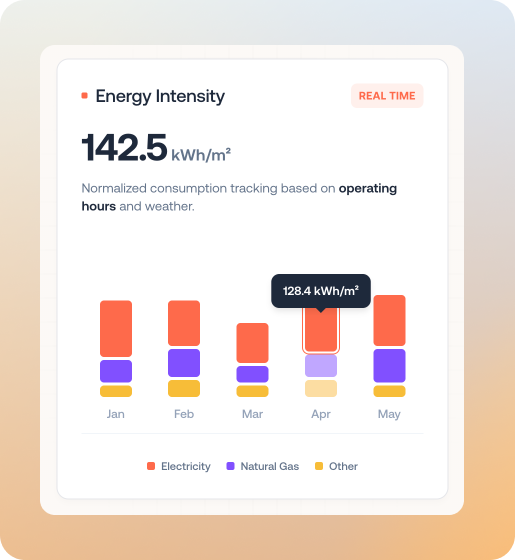
Climate and Seasonality Are Not Noise. They’re Variables.
Energy unit prices shift. Consumption fluctuates year over year based on weather patterns, regional climate differences, and seasonal demand. A store in a coastal city will behave differently than one at high altitude, even if every other variable is identical.
This is why raw consumption numbers, on their own, tell you very little. A 10% increase in energy spend at one location could reflect inefficiency, or it could reflect a colder winter, a tariff change, or a particularly high-footfall period. Without controlling for these factors, you cannot tell the difference.
Meaningful energy analysis requires normalizing for what you cannot control, so you can see clearly what you can.
What Benchmarking Actually Unlocks
Once segmentation is right, the metric is appropriate, and climate factors are accounted for, benchmarking becomes a genuinely powerful tool, not just a reporting exercise.
The right benchmarking framework gives you three things simultaneously.
1- Where you stand in your sector: how does your energy intensity compare to peers operating similar store formats in similar conditions? This is your external reference point, and it tells you whether the problem is industry-wide or specific to your organization.
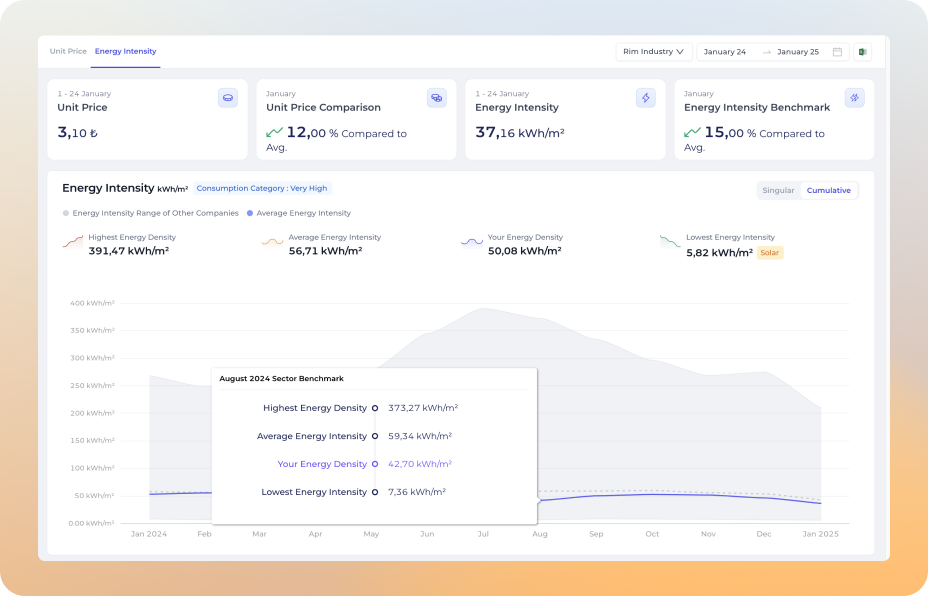
2- Where you stand within your own portfolio: which of your stores are performing significantly below the rest? Where is the efficiency gap largest? Internal benchmarking is often where the most actionable insight lives, because the variables are more controlled and the improvement levers are more direct.
3- Where the quick wins are: the stores at the bottom of your internal distribution are almost always the starting point. They carry the largest gap, the highest improvement potential, and with the right data, a clear enough picture of what is driving inefficiency to act on it quickly. This is how you move from chasing anomalies after the fact to building a focused improvement plan in advance.
The Role of Sector Knowledge and What Apollo Makes Possible
None of this is possible with data alone. Benchmarking requires reference points, and reference points require sector knowledge built across a real portfolio of comparable facilities.
What does best-in-class look like for a mid-size fashion retailer split between mall and high-street formats? What improvement is actually achievable in 12 months for a discount grocery chain, versus what requires capital investment? What are the realistic targets, not just theoretical ones?
These questions cannot be answered from a single company’s internal data.
This is where Apollo changes the equation. Apollo centralizes all your facilities in one platform, segments them correctly by sector, category, store format, and facility type, and runs each store through the analysis framework it actually belongs in. You see where each facility stands relative to its true peer group, not just your internal average. You see where the gap is largest. And you get direct access to the best-practice benchmarks from comparable real-world operations, so you know not just that a gap exists but what closing it actually looks like in practice.
For organizations that go through this process, annual energy savings of up to 25% in targeted facilities are achievable. What makes that number significant is where a large part of it comes from: up to 15% of total consumption can be reduced without any capital investment, purely through how people operate the stores day to day.
Which brings us to a dimension that most energy analyses skip entirely.
In Part 3, we will look at how employee behavior and organizational awareness affect energy performance, and why the gap between your best and worst-performing stores is often not an equipment problem at all.
Ready to Transform Your Retail Energy Strategy?
This is exactly what Apollo’s retail solutions are designed to solve. From segmentation and benchmarking to operational optimization and employee engagement, we help retail organizations move from fragmented data to focused action.