


The annual energy expenditure for a major financial institution; encompassing hundreds of retail branches, thousands of ATMs, and vast corporate headquarters; can reach millions of dollars/euros. Beyond this sheer figure, however, energy consumption and carbon emissions are no longer merely a line item expense; they have become defining factors for corporate strategy, crucial components of ESG performance, and critical drivers of long-term growth.
For CEOs, energy and carbon management has become a strategic priority directly linked to profitability and risk management. CFOs are focused on optimizing energy costs and supporting financial reporting with verifiable data. For COOs, operational efficiency and sustainable growth targets cannot be achieved without effective energy management. A critical question is, or should be, on the agenda for all decision-makers and executives at the corporate leadership level: How will our institution transform energy and carbon management into a strategic advantage within its sustainable growth strategy?
Sustainability is No Longer Optional
Today, sustainable growth in banking signifies more than just environmental responsibility; it translates directly into financial performance, brand equity, and competitive advantage. Global regulatory pressures, investor expectations, and customer preferences are compelling banks to redefine their net-zero strategies. Regulations such as the European Union’s Sustainable Finance Disclosure Regulation (SFDR) and the Corporate Sustainability Reporting Directive (CSRD) are among the mandates closely monitored and prepared for by financial institutions.
In this context, bank energy management and carbon tracking have transitioned from being an operational necessity to a core element of strategic decision-making processes. Branch energy efficiency, ATM energy consumption, and the carbon footprint of corporate headquarters now require visibility in C-level reporting. This is because these data points do more than just generate cost savings; they also provide measurable, verifiable, and strategic high-value insights for banks on their path toward achieving net-zero targets.

Executives’ Priority: Trust and Competitive Advantage
In the global business world, sustainability has become the top priority on the agenda for boards of directors and C-level executives. The figures are striking: 70% of CEOs view sustainability as the most important strategic issue. 70% of firms are restructuring their entire business strategies around carbon reduction. This is not merely a trend; it is a mandatory transformation driven by finance, brand equity, and competitive necessity.
75% of consumers prefer sustainable companies, while sustainable firms are 75% more likely to access financing. In the banking sector, these figures are even more critical: banks with strong ESG performance outpace their competitors in both customer loyalty and investor confidence. Sustainability is no longer a PR exercise; it is a value-creation mechanism that directly impacts profitability, risk management, and growth strategy.
Why Do Sustainability Projects Fail in Banks?
Despite having set sustainability targets, many banks face serious challenges on the path to achieving them. The root causes of failure include:
- High Monitoring Costs and Complex Processes Manually tracking the energy and carbon data of hundreds of branches and thousands of ATMs is both time-consuming and costly. Data collection, validation, and reporting processes remain fragmented and inefficient.
- Lack of Accurate Current State Analysis Sustainability strategy begins with an accurate baseline assessment. Yet most banks jump into automation projects and renewable energy investments without understanding their current facility performance or conducting benchmarks. The result: investments are made, but the real impact cannot be measured.
- Cross-Departmental Silos Energy management stays with technical teams, financial reporting with the finance department, and ESG targets with the sustainability unit. The absence of a shared platform and integrated data makes strategic decision-making difficult.
- Lack of Transparency and Real-Time Visibility Senior executives cannot see energy and carbon performance in real time and with transparency. Data arrives late, reliability is questioned, and strategic decisions lack a solid foundation.
The 3E Perspective for Success in Sustainability
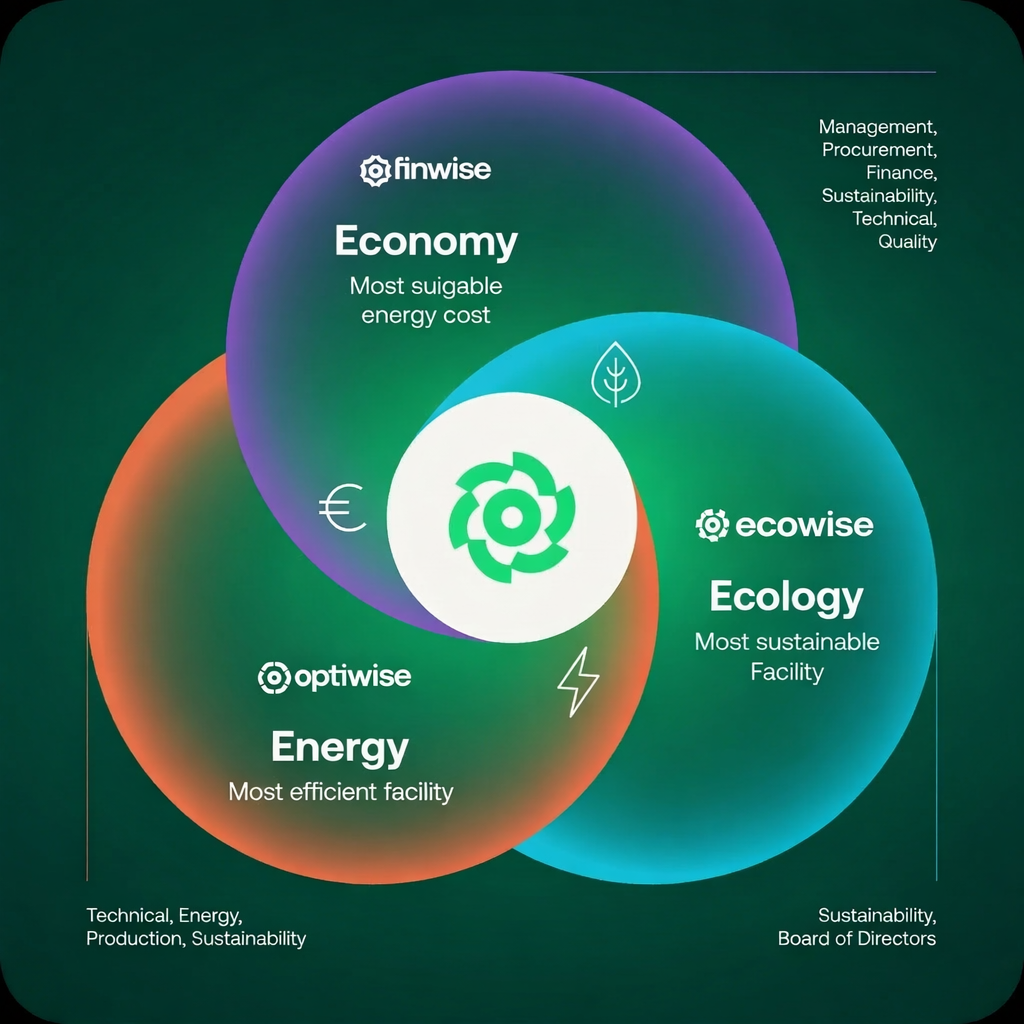
A sustainable growth strategy succeeds through the collective alignment of three core perspectives:
Energy: Monitoring energy consumption, improving efficiency, and capitalizing on savings opportunities. Operational metrics such as branch energy efficiency and ATM energy consumption drive direct cost reductions.
Economy: Integrating energy costs into financial reporting, optimizing budgets, and making data-driven investment decisions. Energy management becomes an inseparable part of financial performance.
Ecology: Measuring the carbon footprint, conducting sustainability reporting, and achieving environmental impact targets. Critical for corporate reputation, brand equity, and regulatory compliance.
These three perspectives form the foundation of a sustainable growth strategy in banking. However, for this integration to succeed, the right starting point is essential: an Accurate Current State Analysis.
Initial Step in Strategy: Accurate Current State Analysis
The primary reason sustainability projects fail is taking a bottom-up rather than top-down approach — making large investments without knowing the bank’s current energy performance, carbon intensity, and cost structure. The correct method is:
❌ Wrong Approach Launching automation and renewable energy projects without knowing facility efficiency or conducting industry benchmarks. Being unable to measure results or demonstrate success.
✅ Right Approach Starting with an accurate current state analysis using a top-down method, then building a strategic sustainability plan.
An accurate current state analysis includes:
💰 Unit Cost Performance and Benchmarking: Branch-level and ATM-level energy cost analysis with industry benchmarks
⚡ Energy Performance and Efficiency Benchmarking: Measuring energy intensity (kWh/m²), unit consumption, and efficiency metrics
💨 Total Carbon Emissions and Comparison: Calculating the carbon footprint and setting targets
For example, if a bank’s branch-level energy intensity is 178 kWh/m² while the industry average is 150 kWh/m², that represents 18% inefficiency. Across hundreds of branches, this gap translates to millions in annual savings potential. But seeing this potential requires an accurate current state analysis first.
Energy and Carbon Management: Transitioning from Operations to Strategy
Traditionally, energy management was perceived as a matter left to technical teams and operational units. Today, however, energy and carbon data have a direct impact on financial reporting, investor relations, and corporate reputation management. Operational efficiency targets and sustainability performance are no longer separate topics — they are an integrated whole.
How will banks monitor energy consumption across hundreds of branches and thousands of ATMs, detect anomalies, and capture savings opportunities? More importantly, how will they turn this data into strategic decisions? At precisely this point, corporate sustainability becomes not just a goal for banks, but a competitive advantage.
Apollo: The Unified Platform for Sustainable Growth in Banking
Apollo is an energy and carbon optimization platform that unifies energy, cost, and carbon management on a single platform, providing senior executives with a strategic decision-support system. Embracing the 3E perspective for sustainability success, it enables sustainability management across the Energy, Economy, and Ecology axes on one platform, delivering strategic advantage. Apollo’s FinWise, OptiWise, and EcoWise modules support banks’ sustainable growth targets across financial performance, operational efficiency, and environmental compliance on a single platform.
*Discover the energy and carbon management platform for bank headquarters, ATMs, and branches now.
Financial Visibility and Strategic Reporting
Energy costs are among the greatest challenges across all industries today, as costs have risen tenfold with the advancing climate crisis. In such a difficult environment, having transparent, verifiable, and trackable energy costs is critical for both financial reporting and profitability. FinWise digitizes and automates the tracking of all energy bills including electricity, water, and natural gas along with cost analysis and financial reporting processes. Using data from primary sources, billing errors are automatically detected, cost items are itemized, and budget management is optimized.
- Enterprise-wide energy cost visibility from a single dashboard
- Financial performance analysis at the branch, regional, and total level
- Automatic detection of budget variances and savings opportunities
- Verifiable financial data for investor reports and sustainability targets, managed from one place
Operational Efficiency and Energy Optimization
Beyond energy costs, operational costs are another reality facing all industries, including banking. Operational efficiency has become a cornerstone of competitive advantage. OptiWise monitors energy consumption in real time across branches and ATMs, detects anomalies, and reports energy savings opportunities. With AI-powered analytics, anomalies in energy use (equipment failures, inefficient operations, unused equipment, etc.) are instantly detected and addressed.
- Supporting operational efficiency targets with energy data
- Branch and ATM-level performance and energy intensity benchmarking
- Proactive maintenance management and cost savings
- Integrated energy management with IoT and smart building technologies
- ISO 50001-compliant reporting provided automatically
Carbon Management and Sustainability Leadership
For all senior executives, carbon reduction performance has become an inseparable part of corporate strategy. EcoWise measures banks’ carbon footprint, manages sustainability reporting, and ensures compliance with sustainability regulations. Scope 1 and 2 emissions are automatically calculated from energy data and reported in compliance with GRI standards and TCFD (Task Force on Climate-related Financial Disclosures) reporting requirements.
- Automatic carbon emission calculations from energy data
- Measurable and transparent tracking of corporate ESG targets
- Carbon data compliant with PCAF and Green Deal standards
- A strategic roadmap toward net-zero targets
- Automatic generation and auditability of sustainability reports
Industry Benchmarking: Discover Your Position in Sustainable Growth
One of the most strategically valuable capabilities is enabling banks to benchmark their own performance against industry averages. Metrics such as branch energy efficiency, ATM energy costs, and carbon intensity can be benchmarked at the branch, regional, and enterprise level. This allows management teams to find data-driven answers to critical questions like “Where do we stand in the industry?” and “How much potential do we have?” through Apollo.
Carbon emission reduction strategies for banks are no longer just about reporting, they have become a tool for creating competitive advantage. With Apollo, banks can prove their sustainability leadership and translate that leadership into brand equity, customer trust, and financial performance.
The Next Generation of Banking: Smart, Sustainable, and Digital
By 2030, banks will be evaluated not only as financial service providers but also as sustainability leaders. AI, IoT sensors, and smart building technologies enable banks to optimize energy consumption, reduce carbon emissions, and lower operational costs.
The bank of the future:
- Smart branches: Real-time energy monitoring, automated climate control systems, and energy-efficiency-focused design
- Digital ATMs: Low-energy equipment, remote monitoring and maintenance, energy-saving operating modes
- Carbon-neutral operations: Renewable energy use, energy storage systems, carbon offset strategies
- Data-driven decision-making: Integration of energy, cost, and carbon data into financial reports and strategic planning
Apollo serves as a strategic partner in preparing banks for this future. The platform doesn’t just solve today’s problems, it makes tomorrow’s opportunities visible.
Success Story: A Leading Financial Institution Transformed Its Energy Management with Apollo
A leading bank operating in Turkey achieved remarkable results through its digital energy management transformation with Apollo. Energy consumption across hundreds of branches and thousands of ATMs became visible on a single platform, the financial reporting process was automated, and operational efficiency targets were met.
Review the detailed case study and explore the bank’s sustainable growth journey.
Strategic Action: Launch Sustainable Growth with Apollo
Sustainable growth in banking begins with reducing energy costs, lowering the carbon footprint, and increasing operational efficiency. But the real value lies in transforming this data into strategic decisions and contributing to the bank’s long-term competitive advantage.
Apollo offers strategic vision for CEOs, financial performance for CFOs, operational excellence for COOs, and sustainability leadership for the entire management team. As an energy and carbon optimization platform, Apollo is a trusted partner in helping banks achieve their sustainable growth goals.
Meet Apollo
Discover Apollo to optimize your bank’s energy costs, reduce your carbon footprint, and achieve your corporate sustainability targets. Fill out the form now to get detailed information about the FinWise, OptiWise, and EcoWise product family and request a demo.
Conclusion: Becoming an Industry Leader in Sustainable Growth
The Turkish banking sector is rapidly undergoing a sustainability transformation alongside its digital transformation. Energy and carbon management is no longer a technical detail, it is a fundamental pillar of profitability, risk management, and strategic growth. Banks leading this transformation gain a critical edge in both financial performance and corporate reputation.
With Apollo, banks reduce energy costs while lowering carbon emissions; increase operational efficiency while achieving ESG targets; optimize financial performance while demonstrating sustainable growth leadership. The bank of the future is sustainable, smart, and digital. Apollo stands alongside the banks building that future today.