


How to reduce energy costs in the UAE when it’s so complicated? you might have thought before.
Ask a finance team in Dubai what they pay per kilowatt-hour and you usually get one number.
There’s no one number.
And that’s where most attempts to reduce energy costs in the UAE come apart before they start.
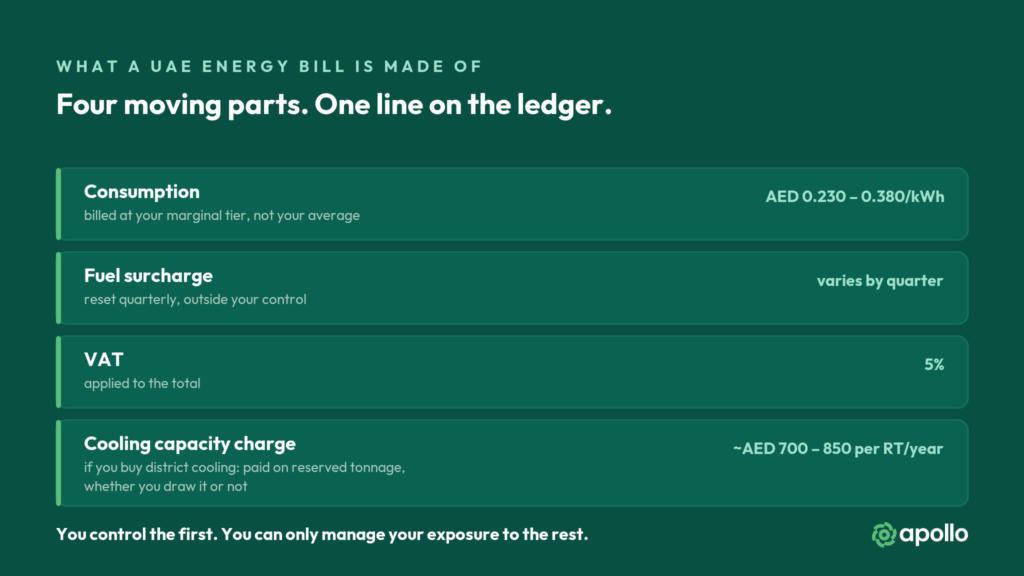
You pay a rate that climbs as you consume, a fuel surcharge that moves every quarter, VAT on top of both, and in many buildings a cooling capacity charge that arrives whether you use the capacity or not. Four moving parts, one line on the ledger.
That’s the first reason energy costs in the UAE are hard to control. Not because the tariff is hidden, but because almost nobody reads the bill as a structure.
The second reason is timing. The same kilowatt-hour costs you different amounts depending on when you draw it and how much you have already drawn that month.
The third is waste, and this is the one that pays best. Most buildings in this region are spending a meaningful share of their bill on consumption that serves nobody, at three in the morning, in an empty building, at the most expensive rate they reach all month.
This guide covers all three: how the DEWA tariff actually works, what slab optimization means in practice, and where the hidden waste sits in a UAE building. Together they are the levers that decide your UAE electricity costs.
- Any serious attempt to reduce energy costs in the UAE starts with the bill’s structure. You pay a slab tariff from AED 0.230 to 0.380/kWh, a quarterly fuel surcharge, 5% VAT, and often a cooling capacity charge.
- You are billed at the margin, not the average. Waste is charged at the highest band you reached that month, so a 10% consumption problem is more than a 10% cost problem.
- Slab optimization means keeping consumption out of the upper bands, which only works on live in-month data.
- Cooling is more than 70% of UAE building energy use, which makes cooling performance, not lighting, the largest opportunity in the building.
- Under Federal Decree-Law No. 11 of 2024, Scope 1 and 2 reporting is mandatory with penalties up to AED 2 million. The same interval data answers the cost question and the compliance question.
What actually drives energy costs in the UAE?
Four things, and only one of them is the rate.
What you consume. Volume, obviously. But volume decides which tier you end up in, and that changes the price of everything above it.
When you consume it. Cooling demand and grid demand peak together in a Gulf summer. A flat load profile through a peaking system is a decision, even when nobody made it on purpose.
What you waste. Consumption that produces no output. Empty-building cooling, overnight lighting, a setpoint nobody reset in March.
What you are billed for versus what you use. Reserved cooling capacity, allocated landlord charges, estimated readings, a tariff class that stopped matching your operation two years ago.
Most attempts to reduce energy costs in the UAE start and end with the first item. The other three are where the recoverable money sits.
How does the DEWA tariff actually work?
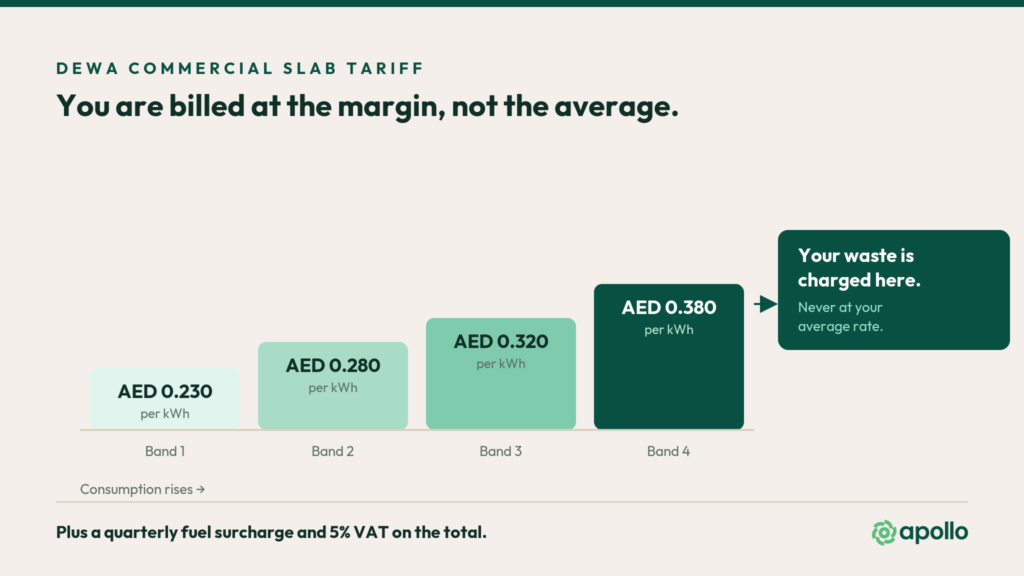
DEWA bills commercial consumption on a slab tariff, which means the rate climbs as consumption rises. Published rates run from AED 0.230/kWh at the lowest band up through AED 0.280 and AED 0.320 to AED 0.380/kWh at the top band.
Then two things get added.
A quarterly fuel surcharge, which moves with fuel costs and is outside your control. And 5% VAT, applied to the total.
So the headline rate is never what you pay.
| Component | How it works | Can you control it? |
|---|---|---|
| Consumption | Slab bands from AED 0.230 to AED 0.380/kWh, billed at your marginal tier | Yes, directly |
| Fuel surcharge | Reset quarterly, applied to consumption | No, only your exposure to it |
| VAT | 5% on the total | No |
| Cooling capacity charge | District cooling only: roughly AED 700 to 850 per RT a year on reserved tonnage | Yes, by right-sizing the reservation |
| Timing | Peak-period load pushes both volume and tier | Partly, for movable load |
The mechanism matters more than the numbers, and this is the part that surprises people:
You are billed at the margin, not the average.
Every extra kilowatt-hour is priced at the highest band you have reached that month. Which means waste never costs you your average rate. It costs you your worst rate.
A 10% consumption problem is more than a 10% cost problem.
Finance teams here almost always quote me an average rate. The average is the one number that never appears on your bill. What you actually pay for the last unit you consumed is the top of the slab, and that is the rate every wasted kilowatt-hour is priced at.
Deniz Sedar Suna
Head of Customer Success, Apollo
What is slab optimization, and how do you actually do it?
Slab optimization is the practice of managing when and how much you consume so that less of your usage falls into the expensive upper bands of a slab tariff. In the UAE that makes it one of the highest-return moves available, because the bands are steep and the top one is where waste gets priced.
It isn’t a trick, and it isn’t tariff arbitrage. It’s three practical moves.
Cut the volume that pushes you upward. The last kilowatt-hours you consume each month are the most expensive ones you buy. So the cheapest saving available to you is the one that keeps you out of the top band. This is why waste reduction pays disproportionately here, and why a saving that looks small in kWh can look large in dirhams.
Know where your threshold sits. You can’t manage a band you’ve never located. Most operators can tell you their monthly total but not which day of the month they crossed into the top tier. That date is the single most useful number in your billing history.
Watch it in-month, not after. By the time the invoice arrives, the tier is set. This only works on live data, because it’s a decision you make on the 18th, not a discovery you make on the 5th of next month.
For a fuller treatment of the tariff mechanics and how they interact with cooling load, our commercial cooling cost optimization guide goes deeper.
Why does timing affect your UAE electricity costs as much as volume?
Because in a Gulf summer, everyone needs power at the same time.
Cooling load peaks roughly between midday and early evening, when ambient temperature and occupancy align. That’s also when the grid is tightest and when demand-related charges bite hardest.
Two buildings can consume identical totals in a month and pay different electricity costs, because one of them drew its load in the expensive hours and the other did not.
Not everything is movable. Retail trading hours are not negotiable, and neither is a hospital. But plenty is: pre-cooling before the peak, thermal storage where it exists, scheduling non-critical plant outside the window, staging equipment start-up rather than firing everything at 08:00.
The prerequisite is knowing your own shape. Which almost nobody does, because a monthly total has no shape.
Where does the hidden waste sit in a UAE building?
This is where the recoverable money actually is, and it’s rarely where people look.
| Where it hides | What it looks like | How you find it |
|---|---|---|
| Closed hours | Cooling, lighting and signage running in an empty building | Compare the overnight baseline against occupied-hours load |
| Setpoint drift | One degree too cold, costing 3 to 5% more cooling power per degree | Track setpoint against consumption per site |
| Equipment degradation | Condenser fouling or refrigerant loss cutting efficiency by up to 15% | Baseline consumption against cooling output, watch the trend |
| Scheduling | Air handling at full capacity in empty zones, plant starting all at once | Read the interval profile against operating hours |
| Over-reserved cooling | Paying every year for tonnage you never draw | Compare contracted RT against peak actual demand |
| The invoice | Wrong tariff class, estimated readings, unauditable landlord allocations | Reconcile every bill to metered data and the contract |
Three of these deserve more than a table row.
Closed-hours consumption
Every building has hours when nobody is in it. The load never drops to zero, and it usually drops far less than operators expect.
Cooling keeps running because a setpoint says so. Lighting stays on in back rooms. Refrigeration and IT never stop. Signage burns through the night.
In this climate the overnight share is higher than in temperate markets, because the building is still fighting a hot night. So the same operational habit costs a Dubai site more than an identical one in Frankfurt.
It also needs no capital to fix. It needs someone to look.
The first thing I ask for is a night. One night of interval data from an empty building tells me more about a site than a year of monthly invoices, because everything still running at three in the morning is running for no reason.
Deniz Sedar Suna
Head of Customer Success, Apollo
Setpoint drift
One degree lower than necessary raises cooling energy use by roughly 3% to 5% per degree, and in a building extracting heat against 45°C exterior the penalty sits at the higher end of that range.
The reverse is where the money is. In one Abu Dhabi hotel study, raising the cooling setpoint produced a 9.28% drop in total building energy use and a 19.53% reduction in annual cooling load, with no capital expenditure at all.
Now multiply one mismanaged degree across forty floors, sixty retail units, or a hospital running around the clock.
Setpoints drift because people are hot, or cold, or because a contractor changed one during commissioning and nobody changed it back. Without monitoring, a drifted setpoint is invisible until it shows up as a slowly rising bill that gets blamed on the weather.
Equipment degrading silently
Condenser fouling can cut chiller efficiency by up to 15%. A minor refrigerant leak degrades COP so the plant does the same work for more electricity. Neither announces itself.
They show up as a bill that creeps, month over month, with no obvious cause. Which is exactly the pattern manual logsheets are worst at catching.
How much of a UAE energy bill is cooling, and what do you do about it?
More than 70% of energy consumption in UAE buildings goes to cooling, according to the Gulf Organization for Research and Development.
Which means cooling isn’t one line item among many. For most operators it’s the bill.
It also means the biggest efficiency opportunity in the building is almost never the lighting retrofit. It’s the thing already installed, running below the performance it was designed for.
Two paths, depending on how you buy your cooling:
If you run your own chillers, the levers are plant sequencing, condenser water optimisation, part-load performance and catching COP decline early. Our guide on commercial cooling cost optimization and multi-site chiller efficiency covers the technical detail.
If you buy chilled water from a district cooling provider, the levers are different and the trap is specific. You pay a consumption charge for the cooling you use and a capacity charge for the tonnage you reserved, roughly AED 700 to 850 per refrigeration ton per year, whether you draw it or not. Estates get sized once at fit-out on a conservative assumption and nobody revisits it. Our district cooling optimization guide breaks down delta-T, kW/RT and the capacity question.
What should you check on your DEWA invoice?
Separate two questions that most teams collapse into one:
→ Are we using the right amount?
→ Are we paying the right price for it?
The second one is faster to answer, and it’s where the quick wins hide.
Tariff class. Operations change. Tariffs often don’t. A classification that fitted the business two years ago may be costing you now.
Estimated readings. Any month billed on an estimate is a month you haven’t verified. Estimates get trued up eventually, but the cash-flow effect and the reporting error are real in the meantime.
Landlord and mall allocations. If you are billed an allocated share rather than a metered consumption, you have a charge you cannot audit. That’s common in mall retail, and it’s worth knowing whether your figure comes from a meter or a spreadsheet.
District cooling capacity versus actual demand. If you have never compared contracted tonnage to peak actual draw, do that before anything else. Over-reservation is one of the largest recoverable costs in a district-cooled portfolio.
Reactive and power factor charges where they apply, and the fuel surcharge line, which should reconcile to the published rate for the quarter.
How do you compare energy costs across multiple UAE sites?
If you run more than a handful of buildings, ranking them on electricity costs is the fastest route to finding money. It’s also the easiest thing to get wrong.
Raw kWh measures what kind of building you have, not how efficiently you run it. Rank a portfolio on total consumption and you’ll point your team at your biggest site, which is rarely your worst.
Intensity varies enormously by format.
A supermarket runs 40 to 60 kWh/m² a month. Fashion retail in winter runs 12 to 18. Compare them directly and the supermarket looks like a disaster while a genuinely wasteful small store never surfaces.
| If you compare on | You are measuring | Use it when |
|---|---|---|
| Total kWh | How big the site is | Never, for ranking efficiency |
| kWh per m² | Intensity of the space | Comparing like formats after climate normalisation |
| kWh per revenue | Energy productivity | Retail and F&B, where trade varies by site |
| kWh per visitor | Load driven by footfall | Malls, hospitality, public buildings |
| kWh per cooled volume | Cooling efficiency directly | Cold storage and cooling-dominated sites |
Two rules make comparison useful in this region.
Segment before you rank. Group like with like, then choose a denominator that reflects what the site is for: per square metre, per revenue, per visitor, per cooled volume.
Normalise for climate before you conclude anything. In a market where cooling is most of the load, an unadjusted month-to-month or site-to-site comparison mostly measures the weather. Gulf operators know this intuitively. It rarely makes it into the numbers they actually compare.
One example from our own data: high-street apparel runs about 30% more energy per square metre than a mall unit of the same brand, 17.4 against 13.4, because the street store carries its own cooling and loses heat through the façade. Same brand, same products, different energy business.
How does UAE regulation change the energy cost equation?
It changed it in 2024, and the first deadline has already passed.
Federal Decree-Law No. 11 of 2024 on the reduction of the effects of climate change makes measuring and reporting Scope 1 and Scope 2 emissions mandatory for companies in the UAE, including those in free zones, with penalties from AED 50,000 up to AED 2 million.
For most commercial operators, Scope 2 is purchased electricity. And purchased electricity is dominated by cooling.
So the dataset that answers your cost question is the same dataset that answers your compliance question. That’s the part finance teams tend to miss, and it changes the business case, because you aren’t funding two projects.
Above that sits the UAE Energy Strategy 2050, which targets a 40% reduction in national energy demand. Demand reduction is now policy, not preference.
And the pressure is not only local. Global demand growth, driven partly by AI data centers, is tightening grids and adding volatility to power prices everywhere. Global prices aren’t yours to set. Your consumption is.
What is the sequence to actually reduce energy costs in the UAE?
The measurement layer already exists in this market, which is what makes the Gulf unusual. DEWA has reached effectively full smart-meter coverage across Dubai, and EtihadWE has completed installation across the northern emirates.
The interval data is being generated. In most buildings it’s used once, to produce a monthly invoice, and then thrown away.
Here is the order we work through with operators.
Reduce energy costs in the UAE
Seven steps, in order
What does reducing energy costs deliver for the business?
Immediate cost recovery: Off-hours waste and billing errors are the fastest money in the building, neither needs a project approval, and because the first wins come from control rather than capital, payback is usually measured in months.
Predictable budgets: Once you can see your shape and your tier, month-end stops being a surprise. You forecast a range instead of explaining a variance.
Capital deferred: Freeing stranded cooling capacity, or right-sizing a reservation, removes spend you’d otherwise commit.
Compliance from the same source: One dataset serves cost control, Scope 2 reporting under Federal Decree-Law No. 11, and any future audit. Cost, carbon and compliance stop being three separate workstreams.
A defensible number: When someone asks why the bill moved, you answer with data rather than a theory about the weather.
How to reduce energy costs in the UAE with an energy intelligence platform?
Every step above needs the same input: interval data, mapped against the tariff you’re actually on. That mapping is what turns a list of good intentions into a way to reduce energy costs in the UAE, and it’s the part almost nobody has.
Finwise takes the money questions. Slab-tier creep, peak exposure, over-reserved cooling tonnage, invoice errors, all surfaced while there’s still a month left to do something about them. That’s steps 3 and 6 above.
Optiwise takes the waste questions. Closed-hours load, drifted setpoints, plant sliding away from its own baseline, and site rankings that account for format and climate instead of ignoring both. Steps 2, 4, 5 and 7.
Ecowise takes the reporting question. One consumption record becomes Scope 1, 2 and 3 figures with a lineage you can trace, which is what Federal Decree-Law No. 11 asks you to stand behind.
Every practical way to reduce energy costs in the UAE depends on data that already exists. Dubai has built the measurement layer. The meters are in, the intervals are recorded.
What most buildings don’t have is a reason to open it before the invoice arrives.
Let’s talk.
Frequently asked questions
How can I reduce energy costs in the UAE?
Start with interval data rather than the monthly bill. The fastest savings are closed-hours consumption, setpoint discipline and invoice errors, none of which need capital. Because DEWA bills at the margin, cutting the consumption that pushes you into the top tariff band saves more per kilowatt-hour than your average rate suggests.
How does the DEWA slab tariff work?
Commercial electricity is billed in rising bands, from AED 0.230/kWh at the lowest through AED 0.280 and AED 0.320 to AED 0.380/kWh at the top, plus a quarterly fuel surcharge and 5% VAT. Because the rate climbs with volume, every additional unit is charged at the highest band you have reached that month.
What is slab optimization?
Slab optimization means managing consumption so less of it falls into the expensive upper tariff bands. In practice that means cutting waste that pushes you upward, knowing when in the month you cross a threshold, and watching consumption in-month on live data rather than discovering the tier after the invoice arrives.
How do I reduce my electricity bill in the UAE?
Start with interval data rather than the monthly invoice, then attack closed-hours consumption, setpoints and invoice errors in that order. Because DEWA bills at the margin, cutting the consumption that pushes you into the top band lowers your UAE electricity costs by more per kilowatt-hour than your average rate implies.
Do UAE companies have to report energy and carbon data?
Yes. Federal Decree-Law No. 11 of 2024 requires companies in the UAE, including those in free zones, to measure and report Scope 1 and Scope 2 emissions, with penalties from AED 50,000 up to AED 2 million. For most commercial operators Scope 2 is purchased electricity, which is dominated by cooling.