


There are a few new things to know about ISO 50001 this year, and most of them have nothing to do with the standard itself. The text barely moved, what moved is the price of ignoring it.
I spend most of my week inside the energy data of companies that are either preparing for an ISO 50001 audit or discovering, late, that they now have to. So before we get into deadlines and penalties, let me clear up the one thing almost everyone gets wrong about this standard.
ISO 50001 is not a tool for watching your electricity bill.
It is a framework for building a systematic management architecture around how your organization uses, measures, and continuously improves its energy.
This ISO 50001 guide for 2026 covers what the standard requires, who now has to comply, the deadlines that apply, and a practical roadmap to get there.
- ISO 50001 is the specialist energy standard: where ISO 14001 covers your whole environmental footprint, ISO 50001 asks how efficient every machine, process, and site actually is.
- The standard runs on a continuous Plan-Do-Check-Act cycle. It is not a one-time audit.
- Under the recast EU Energy Efficiency Directive, a certified energy management system is now mandatory for enterprises consuming more than 85 TJ a year, with a compliance deadline of 11 October 2027.
- The CBAM definitive phase went live on 1 January 2026, turning unverified emissions data into a direct financial liability for EU exporters.
- Spreadsheet-based, invoice-estimated evidence no longer holds up. Auditors now expect granular, automatically captured data.
Before we get into the ISO 50001 guide for 2026, let’s talk some basics:
What is ISO 50001, in plain terms?
ISO 50001 is the international standard for energy management systems (EnMS). It was built by energy experts from more than sixty countries to give organizations one consistent framework for managing energy performance, rather than leaving it to the initiative of a single motivated engineer.
The cleanest way I have found to explain its place in the wider ISO family is this: ISO 14001 is the generalist, ISO 50001 is the specialist. ISO 14001 looks at your total environmental footprint, your waste, water, and pollution. ISO 50001 has one focused question: exactly how efficient is every machine, process, and building you operate, and how do you make it better every year?
The engine behind it is the PDCA cycle: Plan, Do, Check, Act. That structure exists to force continuous improvement. I want to emphasize this because it is the most common misunderstanding I see: ISO 50001 is not a certificate you earn once and frame on the wall. It is a management loop you keep running.
A small but important update worth flagging: ISO 50001:2018 received Amendment 1 in 2024 on climate action. It does not add heavy new requirements, but it now expects organizations to consider whether climate change is a relevant issue for their EnMS and whether interested parties (regulators, customers, investors) have climate-related expectations. It is a signal of where this standard is heading.
What does ISO 50001 actually require?
The standard has ten clauses.
You can read all of them, but in practice three technical pillars carry most of the weight. Get these right and the rest of the system has something to stand on.
| Pillar | What it is | What it answers |
|---|---|---|
| SEUs Significant Energy Uses |
The machines, production lines, or sites that consume the most energy and hold the most improvement potential. ISO 50001 requires you to find them and prioritise them. | Where do we look? |
| EnB Energy Baseline |
A reference point built from historical data. Without a baseline, you have nothing to prove improvement against. | Where did we start? |
| EnPIs Energy Performance Indicators |
The specific metrics that track whether you are getting more efficient. A simple one: kilowatt-hours consumed per ton of output. | Are we moving? |
That is the measurement chain.
- SEU tells you where to look,
- EnB tells you where you started,
- EnPI tells you whether you are actually improving.
Everything else in the standard (policy, objectives, audits, reviews) exists to keep that chain honest over time.
EnPI examples by SEU
| SEU example | Possible EnPI |
|---|---|
| Production | kWh/ton, kWh/unit, Sm³/kg, lt/m² |
| Heating systems | kWh/production volume, kWh/HDD |
| Cooling systems | kWh/production volume, kWh/CDD |
| Compressed air systems | kWh/production volume, kWh per m³ of air produced |
ISO 50001 Guide: Do you actually need ISO 50001 in 2026?
For a long time the honest answer was “it depends, and probably not yet.”
In 2026 that answer changed for a large group of companies, which is the reason why this ISO 50001 guide exists.
It now depends on two things: how much energy you consume, and where you operate.
If you operate in the EU
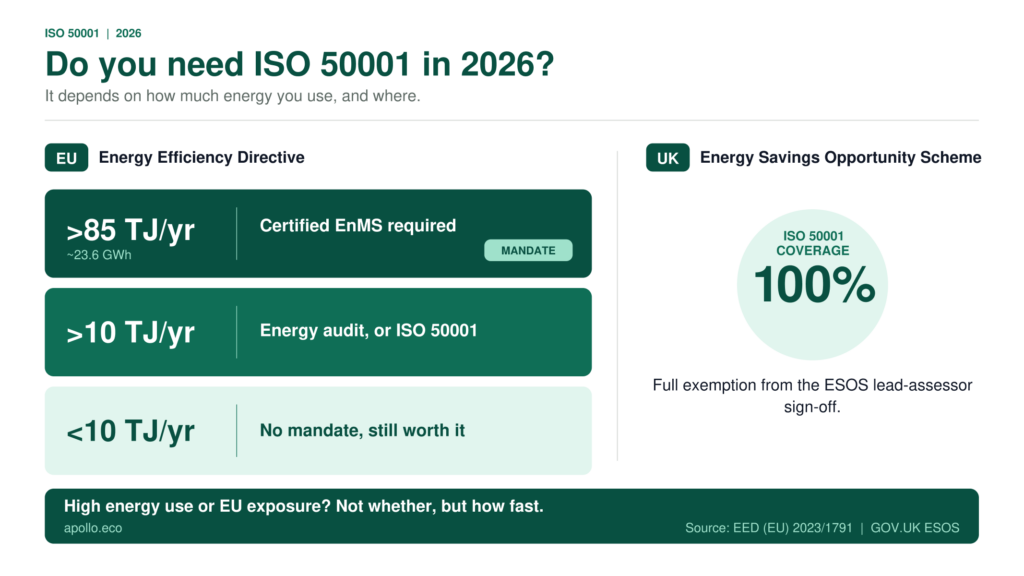
Under the recast Energy Efficiency Directive (EU) 2023/1791, the rules are now explicit:
- If your enterprise consumes more than 85 TJ per year on average (roughly 23.6 GWh, all energy carriers combined), you must implement a certified energy management system. This is a mandate, not a recommendation.
- If you consume more than 10 TJ per year but do not implement an EnMS, you must complete regular energy audits instead. Implementing ISO 50001 replaces that audit obligation.
ISO 50001 is the recognised route to meeting the EnMS requirement, which is why the directive effectively pushes high-consumption companies toward it.
If you operate in the UK
The Energy Savings Opportunity Scheme (ESOS) accepts ISO 50001 as a compliance route. If a certified ISO 50001 system covers 100% of your energy consumption, you are exempt from the ESOS lead-assessor sign-off entirely.
Partial coverage can be combined with ESOS audits to reach the required threshold.
The practical answer
Beyond the legal thresholds, ISO 50001 is most valuable for high-energy industries, multi-site operations, and any company with EU export exposure. If energy is a major cost driver or a compliance risk for you, you need it.
If both are true, the question is no longer whether, but how fast.
ISO 50001 Guide: What changed in 2026, and why it matters now
Here is the part I most want energy and finance teams to internalise.
The ISO 50001 standard did not get harder in 2026. The consequences of not having it did.
Three shifts converged this year and, together, they move ISO 50001 from “good practice” to “non-negotiable” for a lot of businesses.
A short ISO 50001 guide on what changed:
1. The EED mandate is live
The 85 TJ threshold described above is now enforced through national law across EU member states.
The era of treating an EnMS as a voluntary, nice-to-have project is over for large consumers. The clock is running toward the 11 October 2027 compliance deadline, and certification is not something you complete in a quarter.
2. CBAM’s definitive phase started 1 January 2026
The transitional, reporting-only period for the Carbon Border Adjustment Mechanism is finished.
As of 1 January 2026, the definitive financial phase is live: importers of covered goods must purchase CBAM certificates priced against EU ETS carbon values. If you export to the EU, your embedded emissions are now a direct line on your cost structure.
This is where ISO 50001 earns its keep beyond efficiency.
It is one of the primary tools for producing the verified, primary energy data that credible emissions calculations depend on. If you cannot verify your numbers, the EU applies punitive default values and bills you against those.
Default values are designed to be conservative, which is a polite way of saying expensive.
3. Auditors no longer accept the spreadsheet
This is the operational change teams feel first.
Manual spreadsheets and emissions estimated from monthly invoices are no longer accepted as robust EnMS evidence. Assurance reviewers now expect granular, time-stamped, automatically captured data that reconciles to your invoices and your production.
If your energy baseline and EnPIs live in a workbook that one person maintains, that is now a finding waiting to happen.
To iterate the main message of our ISO 50001 guide: The standard barely changed, the cost of ignoring it changed completely.
ISO 50001 in 2026
Key deadlines at a glance
ISO 50001 Guide: A practical ISO 50001 roadmap
The full standard expands into roughly eighteen implementation steps.
That list is useful once you are deep in the work, but it is a poor way to start, because it makes a continuous loop look like a to-do list. I prefer to group the work into four phases that map cleanly onto the PDCA cycle.
| Phase | What you do | PDCA |
|---|---|---|
| 1. Foundation | Capture your current state and energy maturity. Define scope and boundaries (which sites, which energy types). Set an energy policy signed by senior management. Form a cross-functional energy team, not just an energy manager. | Plan |
| 2. Energy review | Build a data collection and calibration plan. Analyse consumption and cost, identify your SEUs, establish your energy baseline (EnB), and define an EnPI for each SEU. This is the heart of the system. | Plan |
| 3. Action | Set measurable objectives and targets on a 4 to 5 year horizon. Map risks and opportunities, build action plans, and embed energy criteria into procurement and design decisions. | Do |
| 4. Operate & improve | Monitor performance against EnPIs, document everything for traceability, run internal audits, and hold management reviews that feed targets for the next cycle. | Check & Act |
A target I like to see written down early, because it forces the whole chain into focus:
“Reduce kWh/ton in production processes by 15% between 2026 and 2030.”
You cannot state that target credibly without an SEU, a baseline, and an EnPI behind it.
ISO 50001 Guide: Your ISO 50001 2026 readiness checklist
Let’s move to the actionable part of our ISO 50001 guide.
If you are starting or revisiting your EnMS this year, this is the short list I would work through before an auditor or a CBAM exposure forces the pace.
ISO 50001 Energy Management System
Your 2026 readiness checklist
10 steps to work through before the EED and CBAM deadlines bite
Reporting that makes your ISO 50001 results visible
Implementation is only half the system.
The other half is reporting that documents progress and survives scrutiny.
Four reports are worth producing on a regular cycle:
- Energy performance reports built on your EnPIs,
- Senior management reports covering progress and strategic targets,
- Monitoring and analysis reports that flag abnormal consumption, and
- External reporting prepared for certification auditors.
In 2026, all four should draw from the same continuous dataset, not from four separate workbooks.
How Apollo helps you do this without spreadsheets
Every requirement in our ISO 50001 guide runs on the same thing: granular, continuous, auditable energy data. That is exactly what Apollo was built to provide, across 3 modules.
→ Optiwise automatically identifies your SEUs and energy baseline, detects anomalies, and benchmarks performance across sites, the core of an ISO 50001 energy review.
→ Finwise monitors energy cost in real time and validates invoices, so your consumption data reconciles to what you actually pay.
→ Ecowise converts that energy data into audit-ready Scope 1, 2, and 3 emissions, which is the bridge between ISO 50001 and your CBAM and CSRD obligations.
No spreadsheets, no estimated invoice math, no single point of failure. If you are working toward ISO 50001 in 2026, that is the foundation worth building on.
Feel free to contact us further regarding the ISO 50001 guide or book a demo. Let’s talk.
Frequently asked questions
Is ISO 50001 mandatory in 2026?
Not universally, but it is mandatory in practice for large EU energy consumers. Under the recast Energy Efficiency Directive, enterprises consuming more than 85 TJ per year must have a certified energy management system in place by 11 October 2027. Those above 10 TJ must run energy audits unless they implement an EnMS instead.
Did the ISO 50001 standard change in 2026?
The core standard, ISO 50001:2018, did not change in 2026. It received a climate action amendment in 2024 (Amendment 1), but the major shift in 2026 is regulatory and financial: the EED mandate, the live CBAM phase, and stricter audit expectations made compliance far more consequential.
What is the difference between ISO 50001 and ISO 14001?
ISO 14001 manages your overall environmental footprint (waste, water, pollution). ISO 50001 is dedicated specifically to energy performance: identifying significant energy uses, setting baselines, and improving efficiency over time.
What are SEU, EnB, and EnPI in ISO 50001?
SEU (Significant Energy Use) is where your biggest consumption and improvement potential sit. EnB (Energy Baseline) is the historical reference you measure against. EnPI (Energy Performance Indicator) is the metric, often energy per unit of output, that shows whether you are improving.
How does ISO 50001 help with CBAM?
CBAM requires verified emissions data for goods imported into the EU. ISO 50001 provides the structured, primary energy data behind credible emissions figures. Without it, exporters risk having punitive default emission values applied to their goods.
Does ISO 50001 satisfy UK ESOS?
Yes. A certified ISO 50001 system covering 100% of your energy consumption exempts you from the ESOS lead-assessor sign-off. Partial coverage can be combined with ESOS audits to meet the requirement.