



When the Science Based Targets initiative published Version 2.0 of its Corporate Net Zero Standard in June 2026, my inbox filled up fast. Sustainability managers, CFOs, procurement leads, all asking the same question in different words:
What does this actually mean for us?
It’s a fair question.
SBTi Net Zero Standard V2.0 is the first comprehensive rewrite of the standard since its launch, and the changes are significant. Not in the sense of raising the ambition bar slightly but in the sense of changing the fundamental logic of what corporate climate commitment means.
After working through the full standard, my honest assessment is this:
V2.0 is not a compliance update but a new operating model.
What’ struck me’s really important from my perspective is that the standard had stopped being something a sustainability team could own. Under V1 you could scope the work, set a target, get it validated, and effectively close the file. V2.0 removes that exit.
There are new tasks that doesn’t sit naturally with a single team like board-level ownership, a transition plan you have to publish, and an end-of-cycle assessment that grades how you did before you’re even allowed to set the next target.
It pulls finance, operations and the board into the room whether they were expecting it or not.
Here’s everything you need to know about the new SBTi Net Zero Standard:
What is the SBTi Net Zero Standard and why does V2.0 matter?
The Science Based Targets initiative (SBTi) is the global body that validates whether corporate climate targets are aligned with the science needed to limit global warming to 1.5°C. If your company has “science-based targets,” it went through SBTi’s validation process. Until now, that process was governed by V1, a framework that functioned largely like a one-time certification.
The logic was that you set a target, got that validated and that was it.
V2.0, which takes effect on February 1, 2027, changes that logic fundamentally. With this ‘update’ to the original, the SBTi net zero standard becomes a continuous management cycle with governance requirements, mandatory planning, annual reporting, third-party assurance, and rolling target cycles. SBTi now describe themselves not as a validator, but as a “transition partner.”
That shift has real operational implications for every company currently inside the SBTi framework and for every company considering entering it.
What’s new in the SBTi V2 standard? The six changes that matter most
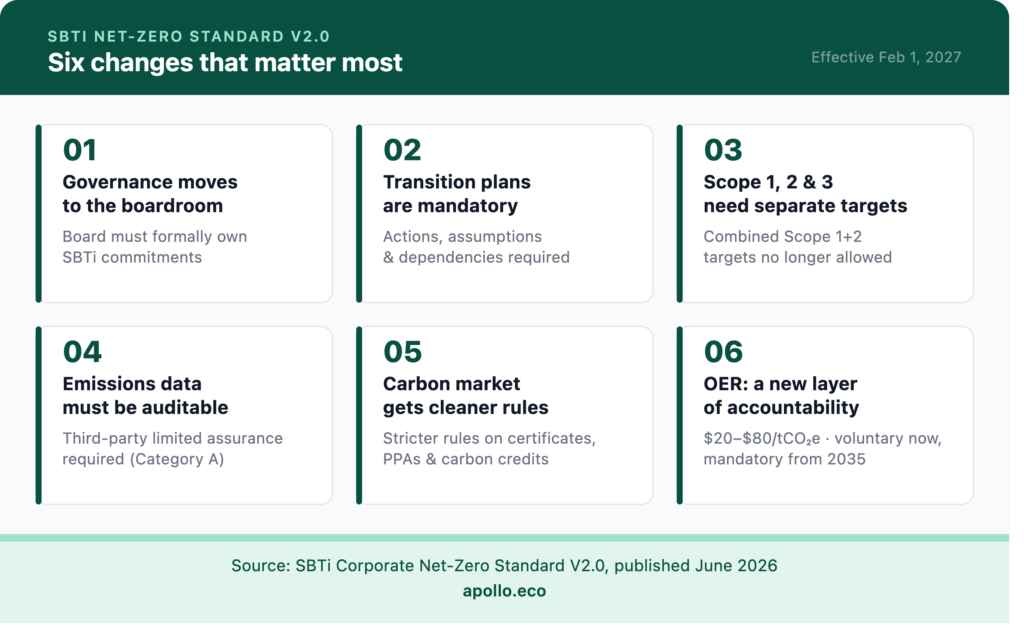
1. Governance moves to the boardroom.
V2.0 requires the company’s highest governance body (the board, or equivalent) to formally own SBTi commitments. Going beyond the sustainability team, board-level accountability for target-setting and implementation oversight is now a documented requirement.
In practice, this is the change that surprises companies most.
They’re used to SBTi being owned by the sustainability function, a technical exercise that produces a validated number. V2.0 makes that impossible.
When board sign-off is mandatory and the transition plan is public, every function that touches emissions has a stake in whether the commitment holds. Companies that have been treating SBTi as a sustainability department project are going to find the governance shift harder than the technical one.
2. Transition plans are mandatory for everyone
Under the V2.0 standard, every company must develop a transition plan that shows not just what they’re committing to, but how they plan to get there, including key actions, assumptions, and dependencies.
For Category A companies (broadly, those with revenues above €450M or more than 1,000 employees), this plan must be publicly disclosed at validation, with a maximum 15-month grace window.
3. Scope 1, 2, and 3 are now separate targets
Under V1, companies could combine Scope 1 and 2 into a single target. V2.0 ends that.
Larger companies must set distinct targets for all three scopes. This matters because the strategies, timelines, and data requirements for each scope are genuinely different and companies that built their V1 targets on a combined basis may find their architecture needs significant rework.
4. Your emissions data now needs to be auditable
Base year emissions data must pass third-party limited assurance for Category A companies.
In my experience, this is the SBTi requirement most companies are least prepared for. If your emissions inventory has been managed in spreadsheets, or built on emission factors that weren’t carefully sourced, the assurance process will surface that.
My professional advice is, get your data foundation right before you fall in love with your strategy.
I’ve watched companies spend months crafting ambitious climate strategies, then stall completely when they realise they can’t reliably measure the emissions they’ve just promised to cut.
V2.0 makes that gap impossible to hide.
Between base-year assurance, the re-baselining each cycle, EIA identification and scope-specific targets, every part of the standard now runs on data that has to hold up to scrutiny. Treat your emissions data the way you already treat your financial numbers:
Maintained continuously, properly documented, capable of being assured, and wired into how the business is run rather than bolted on once a year.
5. The carbon market gets cleaner rules
V2.0 defines exactly which energy certificates, PPAs, and carbon credits count toward compliance and how. Certificates must come from assets no older than 15 years. Electricity supply must come from the same grid region as consumption. Additionality is required for project-level credits.
Buying your way to compliance with low-quality instruments won’t be the easy way out anymore.
6. A new accountability layer for ongoing emissions: OER
Ongoing Emissions Responsibility (OER) is an entirely new voluntary program (mandatory from 2035 for Category A companies) that asks companies to take financial responsibility for emissions they haven’t yet reduced.
The difference is, this isn’t carbon offsetting in the old sense.
OER contributions must be high-integrity, and the price signals are explicit: $20/tCO₂e for the entry level, $80/tCO₂e for leadership recognition. For boards thinking about the cost of slow decarbonization, these numbers are going to matter.
What is the new SBTi net zero target structure?
Under SBTi net zero standard V2.0, companies set two or more near-term targets, each covering a 5-year cycle. The base year is forward-looking, updated at the start of each cycle, which means your emissions inventory has to be current and continuous, not historical.
The thing most companies haven’t absorbed yet is that this turns SBTi into a rolling commitment rather than a single target. V1 cared mostly about the number at the end. V2.0 cares about the path, because how you perform this cycle feeds straight into how steep the next one has to be.
For companies that have treated SBTi as a one-time validation, that’s the part that takes some getting used to. Something else people overlook: if you end a cycle higher than you should have, the standard forces a steeper cut in the next one.
Overshooting buys you a harder target later, not a softer one.
1. Scope 1 Targets
For Scope 1, companies can choose from three approaches:
- Absolute reduction (a straight-line pathway to net zero),
- Intensity reduction (tracking emissions relative to output, using sector-specific pathways), or
- The new “asset transition” method, designed specifically for industrial companies with long-lived physical assets where a linear trajectory simply doesn’t reflect how capital turnover actually works.
2. Scope 2 Targets
For Scope 2, the focus is on low-carbon electricity (LCE); renewables, nuclear, and CCS-equipped generation.
V2.0 introduces stricter rules around certificate age, geographic matching, and hourly consumption matching. Companies with significant electricity consumption will now need to track not just how much low-carbon electricity they’re procuring, but when and where.
3. Scope 3 Targets
For Scope 3, three approaches are available:
- Comprehensive emission reduction,
- Supplier and customer alignment targets, or
- Category-specific targets focused on the highest-impact parts of the value chain.
One important concept worth highlighting is the “best-efforts” principle.
V2.0 explicitly acknowledges that companies don’t control all the variables affecting their emissions. If you document your dependencies and barriers transparently (technology readiness, supply chain constraints, policy gaps, etc.) you can stay inside the framework even if you miss a target.
It’s clear that the expectation the new SBTi net zero standard brings forth is not perfection but rigorous documentation.
What is the SBTi approval process under SBTi net zero standard V2.0?
The SBTi approval process now runs in two distinct stages.
- Target Validation: after a company registers and submits its targets, SBTi verifies that the ambition level meets V2.0 requirements. This is where governance sign-off, transition plan documentation, and base year assurance are reviewed.
- End-of-Cycle Assessment: at the close of each 5-year target period, an independent third-party assessment evaluates whether the company made sufficient progress — using assured emissions data as the basis.
A key point that often surprises companies: SBTi itself does not independently verify your emissions data.
The accuracy and completeness of your inventory is your responsibility and that of your assurance provider. What SBTi validates is whether your targets are ambitious enough and whether your documented process meets the standard’s requirements.
This makes choosing the right data infrastructure and assurance partner early in the process one of the most consequential decisions a company will make.
SBTi V2.0 deadlines: when do the new requirements take effect?
SBTi Net-Zero Standard V2.0
Key deadlines at a glance
The 2027 V1 closure and the 2028 re-targeting wave are the most immediate commercial reality.
Nearly every company currently operating under SBTi will need to rebuild their target architecture under SBTi net zero standard V2.0 within the next two years. That is a significant amount of work, and it all starts with clean data.
Is SBTi certification mandatory? Understanding SBTi requirements
Strictly speaking, no. There’s no law today that says you must hold SBTi-validated targets.
But the more relevant question is:
Who do you answer to, and what do they expect?
Enterprise procurement increasingly includes SBTi alignment as a supplier requirement. Institutional investors use it as a climate risk signal.
In Europe, CSRD and ESRS E1 create regulatory obligations that require essentially the same data infrastructure, governance structures, and reporting cycles that V2.0 mandates. CBAM creates financial incentives for emissions visibility across supply chains that V2.0 also covers.
The SBTi requirements under SBTi net zero standard V2.0 are also more demanding than they were under V1 with board governance, transition plan disclosure, base year assurance, EIA screening.
For companies that have been putting off engagement, the entry bar is higher now than it was.
The practical reality I see is that the companies asking “must we do this?” are being overtaken by the companies already doing it.
SBTi itself may be voluntary, but the data and governance machinery it depends on is fast becoming something you can’t really operate without. The companies I work with have stopped asking whether to do this; the question now is how to do it without overburdening their team.
Your 2026 guide to SBTi net zero standard V2.0: what to do right now
It depends where you’re starting from. Here’s a short action plan for each stage.
1- If you already have SBTi targets under V1
The most important thing is that you don’t assume they roll forward. The scope separation alone can require significant rework with Scope 1, 2, and 3 now needing separate targets.
Start by auditing your current target structure against V2.0 requirements, and begin building your transition plan now. The 2028 deadline sounds far away; transition plans don’t develop quickly once you factor in board approval processes, data gaps, and the new EIA screening requirements.
2- If you’re starting fresh
V1 is still available until the end of 2027 and may offer a faster entry point. But build your data infrastructure to V2.0 standards from the beginning, you’ll need it regardless.
3- If you’re a supplier to a large company
V2.0’s Scope 3 supplier alignment targets mean your customers will likely increasingly ask whether you have your own science-based targets. Getting ahead of that ask is a clear commercial advantage.
The Scope 3 supplier alignment targets in V2.0 mean your large customers are going to start asking whether you have your own science-based targets. The companies already on that path will be easier to work with, easier to finance, and easier to retain as suppliers.
The ones still asking ‘must we do this?’ are facing a competitive compliance gap.
Quick 2026 SBTi Net Zero Standard V2 Checklist
SBTi Net Zero Standard V2.0
Quick 2026 readiness checklist
10 steps to prepare before the February 1, 2027 deadline
How Apollo Can Help
SBTi Net Zero Standard V2.0 made some pretty solid changes that require focus. Every requirement runs on auditable, continuous, scope-specific, real-time data.
That’s the foundation Apollo was built to provide.
→ Apollo’s Ecowise module handles Scope 1, 2, and 3 emissions tracking with the rigour V2.0 demands: base year assurance readiness, EIA screening, and automated reporting aligned to SBTi, ESRS E1, and CBAM from a single data source.
→ The Finwise module manages your energy cost and procurement data, including the low-carbon electricity certificate tracking that Scope 2’s new rules require.
→ The Optiwise module gives you the operational visibility to catch anomalies and efficiency gaps before they show up as target deviations.
Whether you’re starting fresh, planning a re-targeting ahead of 2028, or trying to get your data audit-ready before the February 2027 deadline, we can help. Let’s talk!