


The biggest energy story of 2026 isn’t happening in your buildings.
It’s happening in buildings full of computers, often several countries away. And AI data center energy demand has already reached your invoice.
At Apollo we sit inside the consumption data of companies that have nothing to do with artificial intelligence, from retailers, hospitals, logistics operators to bank branch networks.
Over the past year the same question keeps arriving from all of them, usually from finance rather than engineering:
→ Why is our energy budget behaving differently?
One thing to get straight before we go further, because most coverage of this gets it wrong for an operator.
This is not a data center problem.
It’s a price and availability problem that’s reaching every business connected to the same grid.
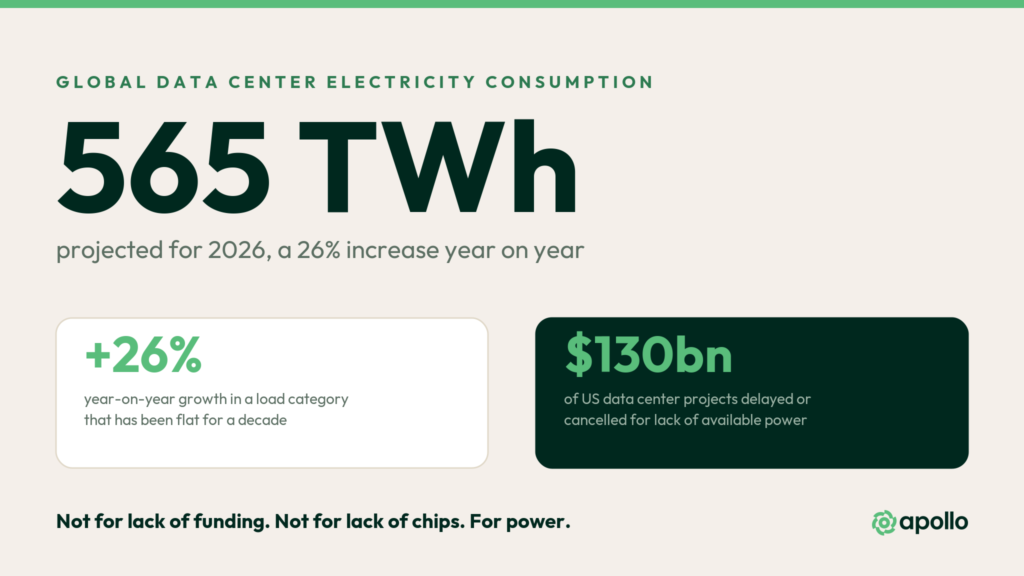
- AI data center energy demand sits inside a global data center total of 565 TWh in 2026, a 26% increase year on year.
- Power is now the leading cause of data center construction delay. At least 75 US projects worth around $130 billion were postponed or cancelled for lack of available power.
- Roughly 2,000 GW of capacity sits in US interconnection queues, and historically only a small fraction of queued capacity is ever built.
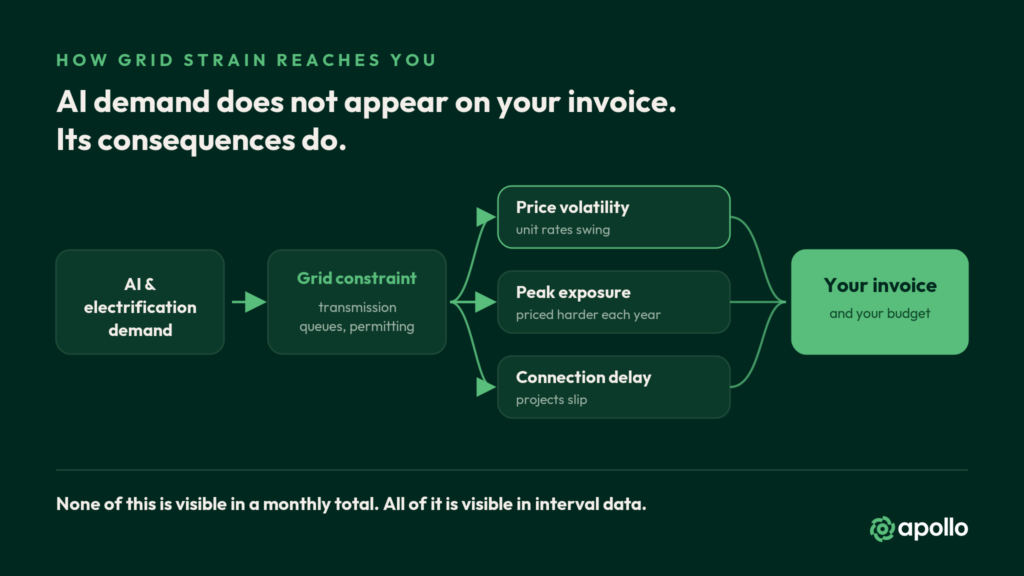
- For ordinary businesses this arrives as three things: price volatility, higher peak exposure, and slower grid connections for new or expanding sites.
- You do not control the price. You control how much you need, which makes efficiency a hedge rather than a nice-to-have.
What is AI data center energy demand in 2026?
AI data center energy demand is the electricity consumed by facilities running artificial-intelligence workloads, and in 2026 it sits inside a global data center total projected at 565 TWh, a 26% increase year on year, according to analysis compiled by Harvard’s Belfer Center.
That’s more electricity than most mid-sized national grids deliver in a year.
Individual sites have scaled with it. A conventional data center campus used to be measured in tens of megawatts. AI campuses are now planned at hundreds, and the largest proposals reach into gigawatts.
That’s power station territory.
Growth like that in a single load category is rare in a mature electricity system. Most demand categories in developed markets have been flat or falling for a decade.
Why do AI data centers use so much electricity?
AI data center energy demand grows on shape as much as size. A traditional data center follows a traffic curve, busy in the day and quiet at night. An AI training cluster doesn’t, because idle silicon is wasted capital, so it runs near capacity around the clock.
Power density per rack has climbed with it. Plenty of new builds have moved from air cooling to liquid cooling because the heat load per square metre outgrew what air can carry away.
What you end up with is a load that is large, flat and permanently on.
Grids find that hard to absorb. They’re planned around peaks and troughs, and a load with no trough removes the slack the whole system runs on.
The vocabulary, in one place
| Term | What it means |
|---|---|
| Baseload | The minimum level of demand on a grid over a period. AI clusters raise it. |
| Load factor | Average demand divided by peak demand. A high load factor means you use the capacity you pay for. |
| Interconnection queue | The waiting list of generation and load projects seeking permission to connect to the grid. |
| Curtailment | Generation that is available but cannot be used, usually because the network cannot carry it. |
| Demand response | Reducing or shifting consumption when the grid is tight, usually in exchange for a payment or a lower charge. |
| Capacity charge | A fixed charge for peak capacity you have reserved, payable whether you use it or not. |
What is the biggest problem facing data center growth right now?
The main problem for data center growth today is not building the facility but getting the power to run it.
At least 75 US data center projects worth roughly $130 billion were postponed or cancelled because power was not available, and power availability has overtaken land and permitting as the leading cause of construction delay in major markets.
You can read that again. These are developers with effectively unlimited capital and secured chip supply, waiting in line for electricity.
For anyone running an ordinary business, that sets the scale of the constraint. If hyperscalers can’t buy their way past it, a retailer opening thirty stores won’t either.
Why is the grid the bottleneck for data center energy demand, not generation?
Because delivery takes far longer to build than supply. A wind or solar farm goes up in about two years. The transmission line that carries its output can take ten, and the queue to connect can absorb several more.
The queues are the evidence.
Roughly 2,000 GW of generation and storage is waiting to connect in the United States, more than the entire installed capacity of the US power system, and historically only a modest share of what enters the queue ever gets built.
Europe arrived at the same conclusion from a different direction. The EU’s Grids Package, backed by the Council in June 2026, targets permitting, planning and cross-border capacity rather than generation targets. That’s a public admission that the network, not the power plants, is the limiting factor.
For twenty years the hard question in electricity was how to build enough clean generation. That question has not gone away, but it is no longer the one that decides what you pay. The binding constraint moved to delivery, and delivery is measured in decades.
Deniz Sedar Suna
Head of Customer Success, Apollo
Does AI data center energy demand raise electricity prices for other businesses?
Indirectly, yes, and mostly as volatility rather than one visible increase. Extra demand on a constrained network tightens the margin between supply and demand, so prices react harder to any disruption and peak periods cost more to serve.
The 2026 European summer showed how it works. Sustained heat pushed summer power prices to levels you normally see in winter, while French nuclear output was cut by around 11% because river water was too warm for cooling. Demand rose and supply fell in the same week.
It swings the other way just as hard. Spain recorded 397 hours of negative electricity prices in the first quarter of 2026, against 48 hours a year earlier.
A market that does both of those things inside twelve months isn’t one you can budget with a single annual figure.
One more thing, because plenty of coverage skips it:
AI data center energy demand is one contributor among several. Electrification of heat and transport, ageing networks and weather extremes all push the same way. For an operator the practical consequence is the same whichever share you assign to each.
How does data center-driven grid strain show up on your electricity bill?
Through five mechanisms. Three of them show up on your invoice, and two never do, which doesn’t make them free.
| Mechanism | What you see on the invoice | What you can do about it |
|---|---|---|
| Price volatility | Unit rates that move between periods, budget variance nobody predicted | Forecast a range rather than a figure, and model exposure before the quarter |
| Peak and demand charges | A charge tied to your highest half-hour, not your total consumption | Find the peak, then shift or shave the controllable part of it |
| Marginal tariff bands | Waste billed at your most expensive rate, not your average | Cut the consumption that pushes you into the top band |
| Connection delay | Nothing. It surfaces as a project that slips | Treat grid capacity as a site-selection input, not a formality |
| Carbon intensity swings | Nothing on the bill. It moves your Scope 2 number | Track emissions on interval data, not annual averages |
The pattern is the same across all five. None of it is visible in a monthly total. All of it is visible in interval data.
The version we see most often goes like this:
A finance team notices the energy line has moved, assumes a metering error, and asks someone to check. The meters are fine, consumption has barely changed. What changed is when that consumption happened, and what those hours cost.
Nobody was watching the shape, because a monthly invoice doesn’t show it.
What does AI data center energy demand mean for operators in the Gulf and Europe?
In the Gulf, the exposure sits in the cooling peak. More than 70% of building energy use in the UAE goes to cooling, and Dubai’s commercial tariff climbs in slabs to AED 0.380/kWh, so waste gets billed at your worst rate exactly when the system is tightest. Growth compounds it, because every new site is another connection request on a network already absorbing fast demand growth.
In Europe, the exposure comes with a regulator attached. The volatility is already in the numbers, and the EU energy-audit deadline of 11 October 2026 requires enterprises consuming more than 10 TJ a year to complete a first audit, with a certified energy management system required above 85 TJ from October 2027.
So European operators get the same question from two directions. Finance asks why the budget moved. The regulator asks what you consumed and where. Both answers come out of the same dataset.
Is the AI data center power crunch temporary or permanent?
Structural, on any planning horizon worth using. AI data center energy demand is not a one-summer event. North American reliability bodies expect the system to be under strain for the better part of a decade, and AI isn’t the only pressure. Heat and transport electrification are adding load to the same networks on the same timeline.
Transmission build times mean relief can’t arrive quickly even where the money is committed. A grid reinforcement approved today arrives in the 2030s.
So plan for volatility as the baseline, not the exception.
That changes what energy management is for. It used to be a cost-reduction exercise you ran when someone asked for savings. It’s closer to risk management now.
How can a business reduce its exposure to energy price volatility?
By reducing how much energy you need and changing when you need it. You can’t influence global demand, the wholesale price, or how fast your network gets reinforced, so every practical lever sits on the demand side.
“Everyone is watching the race to build more power. The companies I work with are finding it inside their own buildings instead. The cheapest megawatt available to anyone is still the one that is never used, and it needs no permit and no queue.
Deniz Sedar Suna
Head of Customer Success, Apollo
Here is the sequence we take operators through.
Energy price volatility
Six moves that reduce your exposure
What is energy efficiency worth under energy price volatility?
More than when prices are stable, because it now buys predictability as well as savings. For a CFO it turns energy from a cost line into a managed exposure, and the return shows up in four places.
- Budget predictability: A modelled range beats an annual estimate that was wrong by March.
- Avoided peak and demand charges: You recover these immediately, and they compound, because peak periods get priced harder every year the system stays tight.
- Capacity headroom: Consumption you remove is capacity you never have to ask for. In a constrained region that can decide whether a site opens on time.
- One dataset, three obligations: The interval data that answers the cost question also answers the audit question and produces your Scope 2 figure. Cost, compliance and reporting stop being three separate projects.
Because the first wins come from operations rather than capital, payback is usually measured in months.
How does an energy intelligence platform help you manage price volatility?
By turning interval data into decisions before the invoice arrives instead of after it. Every move on that list runs on the same foundation: granular, continuous, trustworthy energy data.
→ Optiwise shows the shape of your consumption, finds off-hours and outlier load, benchmarks every site against comparable operations, and flags anomalies in the week they appear rather than in the annual review.
→ Finwise maps consumption against your actual tariff structure, so peak exposure, marginal-band creep and budget variance become visible before the bill instead of after it.
→ Ecowise turns the same data into audit-ready Scope 1, 2 and 3 emissions, which is what EU audit and reporting obligations now expect you to defend.
AI data center energy demand will keep the grid tight for a while. What that costs you depends almost entirely on whether anything is reading your data.
Let’s talk.
Frequently asked questions
How much electricity does AI data center energy demand account for in 2026?
Global data center electricity consumption is projected to reach around 565 TWh in 2026, a rise of roughly 26% year on year. The growth is driven mainly by AI workloads, which run at high utilization around the clock rather than following a daily traffic curve.
Why do AI data centers need so much electricity?
Because AI clusters run near full capacity continuously and pack far more power into each rack than traditional computing. The load is large, flat and always on, which removes the overnight slack that electricity grids are planned around.
How do data centers procure power?
Increasingly through long-term power purchase agreements, dedicated on-site or behind-the-meter generation, and direct deals with utilities for reserved capacity. The shift toward securing power contractually, years in advance, reflects how scarce grid capacity has become in major markets.
Are data centers bad for the environment?
The picture is mixed and depends heavily on the grid they sit on. Their emissions come almost entirely from purchased electricity, so a facility on a low-carbon grid has a very different footprint from an identical one elsewhere. The more immediate issue in 2026 is that added demand on a constrained grid raises carbon intensity for every other user during tight periods.
How can a company reduce peak demand charges?
Start by measuring the interval profile to find where the peak actually falls, since most operators guess wrong. Then cut off-hours consumption, usually the largest recoverable share, and shift controllable load out of the peak window. Continuous monitoring keeps the gains from decaying.